
Mandatory CSR in Indonesia's Tin Province: Empowering Citizens or Triggering Skepticism?
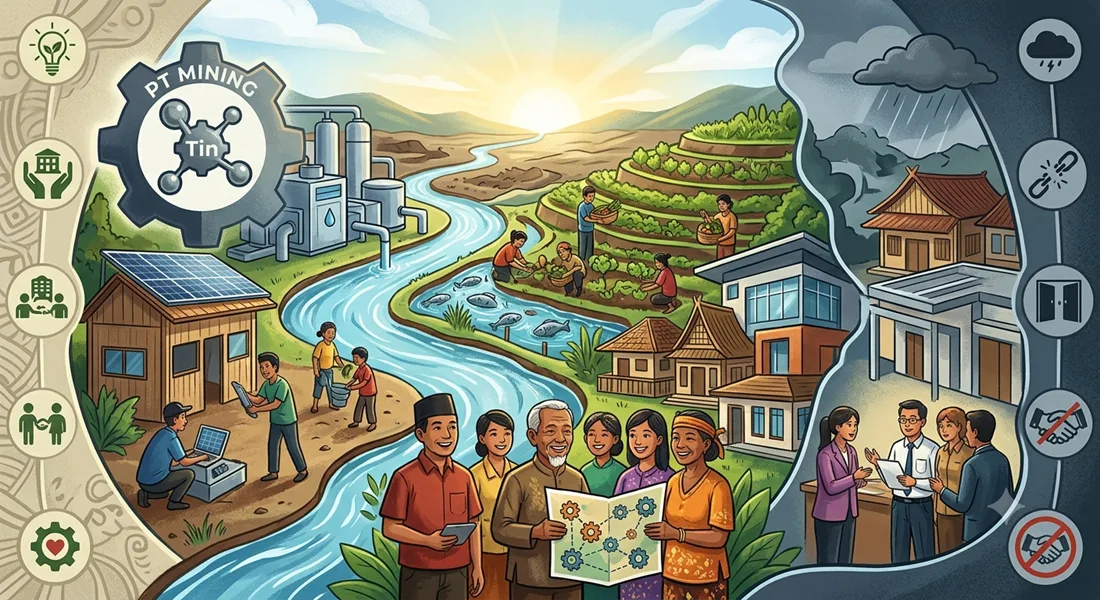
Bangka, – Corporations in resource-rich developing nations have long faced scrutiny over the real-world impact of their Corporate Social Responsibility (CSR) funds. In Indonesia’s tin-mining hub of Bangka Belitung Islands, a pioneering study reveals a complex paradox: while educating local communities about their legal rights to mining revenues effectively amplifies their democratic voice, it simultaneously triggers a wave of skepticism toward third-party development institutions.
The extensive working paper titled "Making CSR work: Evidence from Indonesia's tin mining province" (2026), co-authored by researchers from the Norwegian University of Science and Technology (NTNU), Universitas Bangka Belitung, Gadjah Mada University, and the University of Oulu, delivers rare quantitative causal evidence on how mandatory mining CSR alters grassroots accountability and behavior.
The Hidden Paradox of Resource Abundance
Bangka Belitung is an undeniable global heavyweight in mineral extraction. The province accounts for roughly 90 to 95 percent of Indonesia’s total domestic tin production, positioning the country as the world's second-largest tin exporter. However, the economic boom has left behind massive environmental degradation, severely damaging non-mining livelihoods, land quality, and marine ecosystems.
To address these acute socio-economic disparities, the Indonesian central government implemented the Program Pengembangan dan Pemberdayaan Masyarakat (PPM)—a mandatory, demand-driven form of CSR regulated by Law No. 3/2020 on Mineral and Coal Mining. Unlike conventional voluntary CSR, mining firms are legally obligated to fund community-designed programs, spanning infrastructure, health, and local business development based on a five-year provincial 'Blueprint'.
However, the mechanism has largely faltered. "Funds are frequently unallocated, or their disbursement is exclusively monopolized by village heads," the researchers noted, emphasizing that a staggering 80 percent of surveyed residents had absolutely no prior knowledge of PPM's existence.
+----------------------------------------------------------------------------+
|                       THE TIN MINING REVENUE GAP                          |
|  * 90-95% : Bangka Belitung's share of Indonesia's domestic tin output     |
|  * 70%+   : Tin contribution to the total province exports in 2024          |
|  * 80%    : Local citizens unaware of their mandatory PPM CSR entitlements |
+----------------------------------------------------------------------------+
Inside the Survey Experiment: Videos as Tools for Rights Perceptions
To explore whether this institutional friction could be fixed by bridge-funding the information deficit, the research team conducted a randomized pre-registered survey experiment involving 610 adult respondents across 35 mining communities in Bangka. The subjects were exposed to different video interventions:
Treatment 1 (T1): Provided pure, fact-based statutory information detailing the legal structure of PPM and citizens' rights to these mining revenues.
Treatment 2 (T2): Combined the basic informational core with real-world, inspirational 'role model' examples of villages successfully utilizing PPM funds to establish small enterprises and agricultural programs.
Placebo Group: Watched a neutral video concerning Indonesian agriculture to rule out the experimenter demand bias.
The results exposed a striking behavioral divergence.
The Causal Friction: Rights vs. Actions
When citizens watched the pure informational video (T1), it powerfully ignited their sense of entitlement. T1 generated a significant positive shift (+0.21 to +0.23 points on the Likert scale) in respondents' beliefs that they possess a legal right to directly benefit from the corporate revenues of tin giants like state-owned PT Timah.
Yet, this sudden surge in political awareness caused a surprising backlash. Rather than increasing civic participation, the pure information treatment reduced the likelihood of citizens making voluntary financial donations to a local development NGO, the Gubuk Foundation, by approximately 5 percent.
The data suggests that when individuals learn that multi-billion dollar mining companies are legally mandated to bankroll local development, they experience a psychological shift. They begin to view community welfare not as a matter of private charity or third-party NGO intervention, but as a rigid statutory obligation that must be directly fulfilled by corporations and state regulators.
The Role Model Multiplier Effect
On the other hand, the role-model treatment (T2) offered a much sturdier path toward active citizenship. When the factual data was paired with tangible success stories, it didn’t just boost people’s perceived right to benefit (+0.33 to +0.35 points); it also radically enhanced their self-efficacy.
Respondents exposed to T2 demonstrated a robust belief in their right to actively influence corporate decision-making and spending (+0.20 to +0.22 points). Furthermore, it directly translated into proactive, information-seeking intent, significantly increasing the likelihood that they would officially request formal documentation regarding resource revenue management.
Heterogeneous Reperceptions: Not All Citizens React Equally
The study’s econometric modeling unearthed deep behavioral nuances when factoring in pre-existing socioeconomic demographics:
Civic Associations: Members of local farmer and fisher associations—who bear the worst brunt of industrial tin pollution—showed a massive willingness to engage, recording higher donation frequencies and substantially larger donation amounts after viewing the T2 video.
Economic Aspiration: Citizens who expressed satisfaction with their household’s current economic situation reacted to the role-model treatment by feeling less personally entitled to resource revenues, yet they volunteered to donate significantly more capital to support more vulnerable mining tracts.
The Trust Factor: Interestingly, citizens who harbored an innate trust in local mining companies felt more empowered to influence spending pipelines after receiving the treatments, whereas those with strong institutional trust in government leaders tended to decrease their civic donations, expecting state mechanisms to pick up the slack.
Institutional Overhaul Over Factual Fixes
The overarching conclusion of this rigorous working paper serves as a vital blueprint for resource nationalism and ministerial policy. While tailored information campaigns are highly effective at raising community awareness and stimulating grassroots demand, information alone is an insufficient silver bullet for structural governance failure.
"Information and role-model interventions should not be viewed as substitutes for stronger institutional supply-side reforms," the authors warned. For mandatory CSR programs like Indonesia’s PPM to truly alleviate resource curse dynamics, regulators must couple public awareness campaigns with ironclad institutional channels—such as transparent project pipelines, binding corporate reporting standards, and accessible public grievance mechanisms.
Without these structural channels to convert newly found citizen awareness into enforceable corporate accountability, the mandated millions intended to empower Indonesia’s mining provinces risk remaining entirely out of reach.
Source: Scherzer, S., Brunnschweiler, C., Elgifienda, T., Hyldmo, H. d. S., Kurniawan, N., Lujala, P., & Putri, P. (2026). Making CSR work: Evidence from Indonesia's tin mining province (Working Paper Series No. 3/2026). Department of Economics, Norwegian University of Science and Technology. http://www.ntnu.edu/econ/working-papers
Cover Image Source: Generated by AI / Image generated using artificial intelligence tools.