
The Sacred Harmony of Pelangas: Unveiling the Myth and Semiotics Behind the Jerieng Tribe’s Sedekah Gunung Tradition
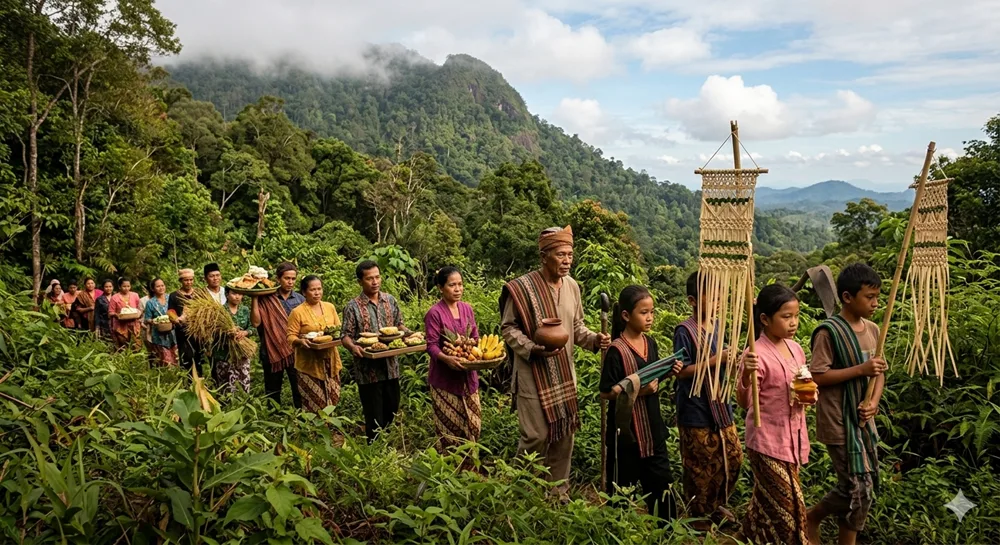
BANGKA – Amidst the relentless waves of globalization and cultural shifts among the younger generation, the indigenous Jerieng Tribe in Pelangas Village, West Bangka, stands resilient in safeguarding their ancestral legacy. A recent research paper published in the English Review: Journal of English Education (February 2025) highlights how this community meticulously maintains the Sedekah Gunung (Mountain Offering) ritual, a deeply spiritual tradition rooted in ecological myths and cosmic harmony.
The study, spearheaded by researchers Andri Fernanda, Irvan Ansyari, and Arthur Muhammad Farhaby from the Faculty of Social and Political Sciences at Universitas Bangka Belitung, uses Charles Sanders Peirce’s triadic semiotic theory to decode the hidden messages, symbols, and values embedded within the tradition.
A Ritual Timed by the Moon
The Sedekah Gunung tradition is an annual procession performed precisely on the 14th night of the full moon. The name itself is derived from a local hill that the community revered as Gunong.
"The ritual serves as a profound expression of the tribe's gratitude to nature for the bountiful harvest and natural resources accumulated throughout the year," the researchers noted in their report. "It is also a spiritual plea for an even more prosperous yield in the coming year."
The execution of the ritual is split into a meticulous two-day phase. It begins with Gotong Royong—a communal cleanup of the village paths and the forest trails leading up to the hill. Families decorate their front yards and prepare traditional delicacies derived from their annual harvest. On the eve of the main ritual, the community gathers for vibrant cultural art showcases, including local dances and silat (martial arts).
The apex of the preparation occurs at midnight through a cleansing ritual known as Mandi Gong. Villagers gather at the residence of the village shaman (dukun) to bathe in water sourced from seven different natural springs, symbolizing absolute spiritual and physical purification before interfacing with the sacred mountain.
Decoding the Signs: The Semiotic Perspective
Applying semiotic markers—comprising the Representamen (the sign), the Interpretant (the meaning), and the Object (the physical matter)—the research unpacks the dense symbiotic worldview of the Jerieng people.
The act of cooking communal meals using the fresh harvest and intentionally leaving a portion of the food, such as turmeric, jasmine flowers, and honey, at the peak of the hill is identified as a primary representamen. Semiotically, this represents the Jerieng Tribe's unyielding belief in the "cycle of give and take" between humanity and the environment.
Furthermore, the tradition enforces a strict three-day taboo (pantangan) immediately following the festival. During this period, all villagers are strictly prohibited from farming, fishing, or slaughtering livestock.
"This temporary cessation of productive activities functions as a structural break for nature," the study explains. "Because the community utilizes natural resources all year long, this forced hiatus allows the ecosystem to rest, rejuvenate, and recover from human interference."
When the Balance Breaks
The myth surrounding Sedekah Gunung is far from being viewed by locals as a mere fairy tale; it carries tangible, real-world consequences for the community. The researchers documented a striking historical account from Datuk Janum, the village shaman and traditional leader of the procession.
During the COVID-19 pandemic in 2020, severe public health restrictions forced the Jerieng Tribe to postpone the Sedekah Gunung ritual. Consequently, the village suffered consecutive years of devastatingly poor crop harvests. For the Jerieng people, this ecological failure was direct proof of the myth: neglecting communication and reciprocity with the spiritual guardians of nature disrupts the agricultural balance.
As Masliadi, the head of the Pelangas Village Tourism Awareness Group (Pokdarwis), observed, "Through Sedekah Gunung, we are taught from a young age to be wise in managing our natural resources, to share with others, and to respect the environmental boundaries set by our ancestors."
Preserving Local Wisdom
Beyond its mystical and semiotic frameworks, the Sedekah Gunung tradition carries immense contemporary moral weight. It fosters a deep-seated commitment to human-to-nature and human-to-human harmony, strengthens social solidarity through communal feasts, and enhances regional collaboration.
The academic review underscores that keeping such oral literatures and indigenous traditions alive is paramount for Bangka Belitung's cultural preservation. In a modern world increasingly detached from environmental ethics, the Jerieng tribe's ancient mountain offering stands as a brilliant masterclass in sustainable living and ecological respect.
Source: Fernanda, A., Ansyari, I., & Farhaby, A. M. (2025). A SEMIOTIC ANALYSIS OF JERIENG TRIBE’S SEDEKAH GUNUNG TRADITION. English Review: Journal of English Education, 13(1), 329-338. https://doi.org/10.25134/erjee.v13i1.10841