
Tourism vs. Mining: The Contested Coastal Spaces of Tanjung Putat and Lepar Beaches in Bangka Regency
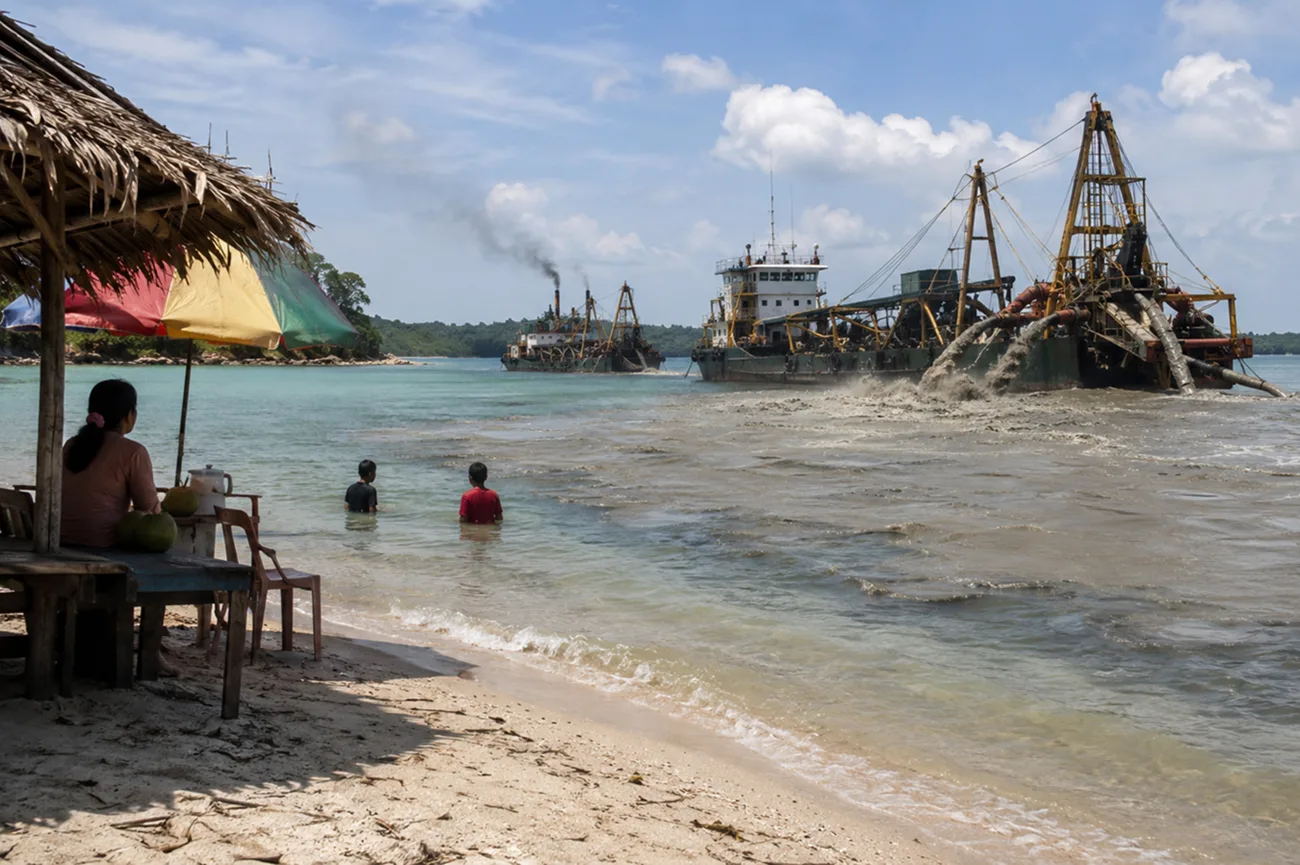
BELINYU, BANGKA REGENCY — The Bangka Belitung Islands Province, long celebrated for its pristine waters and rich tin reserves, stands at a critical socio-economic crossroads. While tin extraction has historically served as the economic backbone of the region since the colonial era, local authorities and communities are increasingly turning toward coastal tourism as a sustainable post-mining alternative. However, a growing spatial contestation along the coastline of Belinyu District highlights the severe frictions that arise when destructive extractive industries collide directly with eco-tourism initiatives.
According to a comprehensive research study authored by Berlian Zarina, Ibrahim, Rini Arcdha Saputri, and Rendy from the Department of Political Science at Universitas Bangka Belitung (published in Berumpun: International Journal of Social, Politics, and Humanities, Vol. 4 No. 2), the adjacent waters of Tanjung Putat Beach and Lepar Beach have become a battlefield of ecological, economic, and political interests.
The Shift to Marine Extraction and Its Environmental Toll
Historically, tin mining in Bangka was conducted onshore. Decades of continuous exploitation, however, have depleted terrestrial tin reserves, raised operational costs, and degraded mainland ecosystems. In response, mining enterprises—including state-backed operators like PT Timah and their private partners—have shifted their focus offshore, deploying Production Suction Ships (Kapal Isap Produksi or KIP) and Production Suction Pontoons (Ponton Isap Produksi or PIP) dangerously close to the shoreline.
In Belinyu District, mining remains the dominant economic sector, employing over 13,700 individuals compared to 1,250 in fisheries and roughly 2,051 in local trade. Despite this dominance, offshore dredging generates severe environmental degradation. Seabed dredging discharges unprocessed tailings—consisting of mud, clay, sand, and stone—directly into the surrounding waters. Driven by ocean currents, this waste drastically increases sea water turbidity, turning crystal-clear coastal waters cloudy and ruining the aesthetic value of local beaches.
+-----------------------------------------------------------------------+
|                      OFFSHORE MINING DREDGING                         |
|   - Production Suction Ships (KIP) & Pontoons (PIP)                   |
|   - Discharges tailings (mud, clay, sand) directly into the sea       |
+-----------------------------------------------------------------------+
                                   |
                                   v
+-----------------------------------------------------------------------+
|                       ENVIRONMENTAL IMPACTS                           |
|   - Extreme seawater turbidity (cloudiness)                           |
|   - Degradation of coastal ecosystems & marine habitats               |
|   - Air and noise pollution from pontoon smoke                        |
+-----------------------------------------------------------------------+
                                   |
                                   v
+-----------------------------------------------------------------------+
|                       SOCIO-ECONOMIC FALLOUT                          |
|   - Decline in tourist arrivals and local vendor incomes              |
|   - Destruction of swimming and recreational safety                   |
|   - Reduced catches and income for local fishermen                   |
+-----------------------------------------------------------------------+
Theoretical Framework: Henri Lefebvre’s Production of Space
To explain how these overlapping activities generate conflict, the researchers applied French philosopher Henri Lefebvre’s Concept of Spatial Production. Lefebvre posits that space is not a neutral, passive container, but rather a political product shaped by capitalism, power dynamics, and social practice. The study breaks down this contestation into three core dimensions:
Spatial Practice (Use of Space): The daily physical utilization of the coastline. Local communities, small-scale vendors, and tourists utilize Lepar and Tanjung Putat beaches for recreation, swimming, and micro-commerce. Simultaneously, offshore mining pontoons operate merely 250 to 800 meters from the shore, polluting the water and disrupting recreational use.
Spatial Representation (Conceived Space & Policy): The administrative and legal frameworks created by state actors. Spatial allocation is governed by Regional Regulation No. 3 of 2020 on the Zoning Plan for Coastal Areas and Small Islands (RZWP3K). Under this master plan, offshore mining zones were legally mapped out in close proximity to coastal lands. While Lepar Beach secured official legal status as a protected forest turned tourism area under a 2018 Decree from the Ministry of Environment and Forestry, Tanjung Putat Beach remains administratively classified as an industrial area, leaving its emerging tourism sector legally vulnerable.
Representational Space (Lived Experience & Resistance): The emotional and lived reality of the local population. Disillusioned by declining tourism revenue and ecological degradation, local activists—such as the Pokdarwis (Tourism Awareness Community) and Greenboys—alongside local fishermen, organized grassroots protests targeting mining companies and government institutions.
Comparing Sectoral Contributions: Mining vs. Tourism
Although regional development policies (RPJMD and RPJPD) explicitly designate tourism as the ultimate replacement for finite mineral resources, revenue data highlights an ongoing economic dependence on tin.
| Year | Mining Sector Revenue (IDR) | Tourism Sector Revenue (IDR) | Total Regional Original Income / PAD (IDR) | Mining Contribution (%) | Tourism Contribution (%) |
| 2014 | 59,591,345,847 | 31,742,903,149 | 427,580,506,879 | 13.94% | 7.42% |
| 2015 | 35,230,805,563 | 35,576,078,187 | 599,620,953,180 | 5.93% | 5.92% |
| 2016 | 72,771,417,844 | 47,957,942,361 | 663,445,639,676 | 10.97% | 7.23% |
| 2017 | 96,237,290,589 | 49,857,480,706 | 879,784,561,698 | 10.94% | 5.67% |
| 2018 | 114,215,783,026 | 57,595,728,153 | 848,330,012,018 | 13.46% | 6.79% |
(Data compiled from the Regional Finance Agency of Bangka Belitung Islands Province)
While tourism revenue grew steadily to over IDR 57.5 billion in 2018, short-term state revenue from tin mining continues to overshadow coastal conservation. This creates a policy paradox: government agendas promote sustainable green growth, yet spatial zoning policies permit destructive extractive operations immediately adjacent to active tourist shores.
Grassroots Protests and Governance Shortfalls
The presence of heavy marine mining equipment, black engine smoke, and polluted waters led to formal protests from local community coalitions. Environmental activists and fishermen escalated grievances to local authorities, naval commanders, and provincial government bodies.
However, high-level structural policy changes remain elusive. District and provincial officials largely dismissed further intervention on the grounds that disputes had been legally "settled" at the sub-district level and that mining operators were operating within legally designated RZWP3K boundaries. Consequently, community members and local tourism vendors are left bearing the ecological and economic burdens of reduced visitor counts and degraded coastal environments.
Conclusion & Key Takeaways
The study demonstrates that without strict, ecologically aligned spatial planning, Bangka's ambition to transition from an extractive economy to a sustainable tourism hub remains compromised. Allowing high-impact marine tin mining in close proximity to developing beach destinations degrades the very environmental assets required for post-mining economic survival. Resolving spatial contestation in Belinyu requires binding policy commitments that prioritize long-term ecological health and community-based tourism over short-term resource extraction.
Source: Zarina, B., Ibrahim, Saputri, R. A., & Rendy. (2021). Tourism versus mining: Contested space in Tanjung Putat Beach and Lepar Beach, Belinyu District, Bangka Regency. Berumpun: International Journal of Social, Politics, and Humanities, 4(2), 184–195. https://doi.org/10.33019/berumpun.v3i1.62
Cover image source: Image generated by AI.