
Beyond Numbers: Why Indonesia Still Lacks Substantive Representation for Women in Parliament
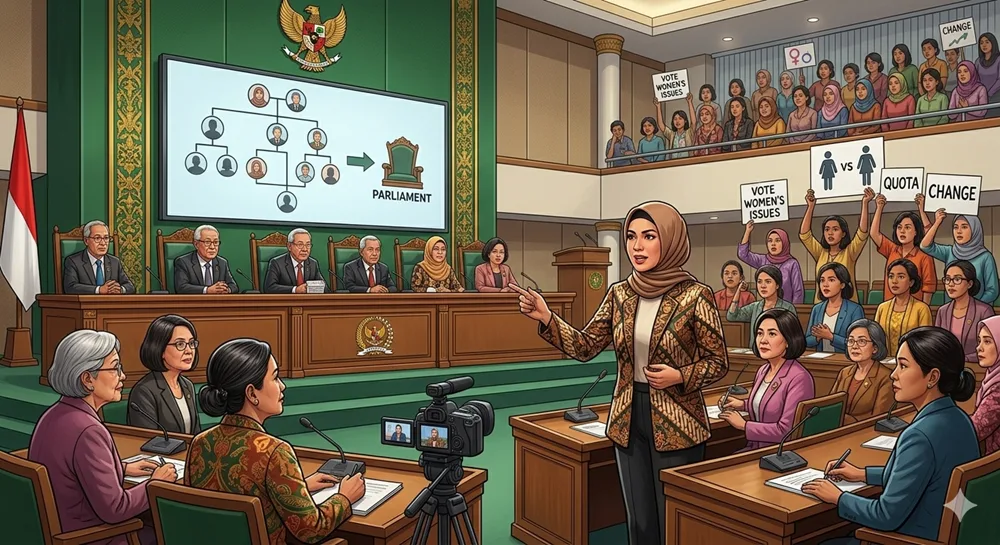
YOGYAKARTA – For the past twenty-five years, gender and political scholars across the globe have engaged in fierce debates regarding the true meaning of women’s political representation. Is the physical presence of female legislators enough to guarantee that women's rights and needs are being defended?
A comprehensive literature review published in Jurnal Wacana Politik (October 2023) exposes a glaring gap in political science research. The study reveals that while the global academic community has thoroughly dissected how women get elected, it has largely ignored whether their presence translates into real, impactful policy changes—particularly in Asian nations like Indonesia.
The paper, titled "Political Representation Of Women In Parliament: A Literature Review And Future Research Opportunities," was conducted by researchers Rini Archda Saputri, Mada Sukmajati, and Desintha Dwi Asriani from Universitas Gadjah Mada (UGM). By analyzing 81 high-impact peer-reviewed papers from Scopus and JSTOR over the last three decades, the UGM team mapped out the structural barriers facing female politicians.
The Mirage of the 30 Percent Quota
Borrowing the foundational political theory of Hanna Pitkin (1967), the researchers separate representation into two main dimensions: descriptive representation (mere presence or structural resemblance) and substantive representation (the actual act of fighting for constituents' interests).
"In the perspective of descriptive representation, what matters most is presence," the authors noted. "A female parliamentarian represents women simply by sitting in the room."
In Indonesia, this concept is manifested through the 30 percent legislative quota and the "zipper system" designed to ensure female candidates are placed prominently on ballot papers. However, the UGM study points out that these numerical targets have become a mirage due to a highly liberalistic and open proportional election system.
Worse yet, institutional interventions are frequently hijacked. In the Indonesian context, the research highlights that a staggering 44 percent of women elected to the national parliament during the 2019–2024 period did not ascend through grassroots merit. Instead, they belonged to deeply entrenched political dynasties.
"It is not uncommon for political parties to nominate women from powerful dynasties just to secure seats," the researchers wrote. "Ultimately, seats only pass from seasoned female politicians to newcomers who often have no credentials other than their family ties, leaving the actual representation of women unchanged."
Beyond dynastic politics, female candidates in Indonesia must battle formidable ideological walls, including widespread patriarchal attitudes and religious fundamentalism, which severely limit their mobility before they even launch a campaign. To survive, female politicians are often forced to adjust their imagery—such as strategically modifying their hijab styles—or rely heavily on the financial backing of male relatives.
The Great Substantive Vacuum in Asia
The most critical finding of the UGM study is the massive academic and practical vacuum surrounding Substantive Representation of Women (SRW) in Asia.
While Western countries like the United States, Australia, and European nations have established rich data on how female politicians successfully pass laws protecting maternal employment, healthcare, and gender equity, Asian data—especially from Indonesia—remains drastically under-explored.
According to the literature, achieving substantive policy outcomes requires more than just filling seats. It requires specific institutional catalysts. Studies from other democratic countries indicate that women's substantive representation only succeeds under three conditions:
The Presence of Critical Actors: Legislators who are actively feminist, rather than just biologically female, who aggressively launch women-friendly bills.
Institutional safe spaces: Dedicated gender-focused parliamentary caucuses that allow women to build cross-party coalitions independent of oligarchic party leaders.
A Strong Alliance with Social Movements: Deep ties between women parliamentarians and civil society organizations to mobilize external public pressure.
In Indonesia, political parties are strictly controlled by oligarchs who dictate legislative priorities and ideological structures, effectively choking the independence of female lawmakers. When these institutional support networks are missing, substantive representation falls apart entirely.
The Academic Debate: Do Numbers Actually Matter?
The UGM review highlights a sharp, ongoing schism among global political economists and gender experts regarding whether increasing the number of women actually changes anything.
On one side of the aisle, optimists like Kittilson (2008) and Weeks (2017) present cross-country statistical evidence proving that a higher fraction of female legislators directly correlates with the passage of priority bills addressing women's issues. They argue that as numbers grow, women gain the critical mass needed to shift the policy landscape.
On the flip side, critical scholars present a sobering counter-narrative. A famous study titled "Do Women Need Women Representatives?" by Campbell et al. (2010) discovered that an increase in numerical representation can sometimes backfire and have negative implications if the political elite merely reproduces the polarization of the masses.
Furthermore, classic political economy theories, such as the Median Voter Theory, suggest that politicians will always flock toward whatever platform secures their re-election, regardless of their gender identity. In a perfectly strategic political arena, personal characteristics become completely irrelevant to policy outcomes.
A Call for Future Research
The UGM researchers conclude that parliaments are strictly shaped by the political culture and party systems of their home countries. Therefore, Western indicators of political success cannot be copy-pasted onto the complex reality of Indonesian democracy.
With the next electoral cycles on the horizon, the paper issues an urgent call to action for Asian academics to shift their focus away from ballot boxes and start examining what happens inside legislative halls. Until the region gathers hard empirical evidence on how to transform descriptive presence into substantive policy, the fight for true gender equity in parliament will remain an uphill battle.
Source: Saputri, Rini Archda; Sukmajati, Mada; and Dwi Asriani, Desintha (2023) "Political Representation Of Women In Parliament: A Literature Review And Future Research Opportunities," JWP (Jurnal Wacana Politik): Vol. 8: Iss. 2, Article 10.
Available at: Political Representation Of Women In Parliament: A Literature Review And Future Research Opportunities