
Boosting Sharia Economy: How Effective is the OPOP Program in Transforming Belitung's Pesantrens?
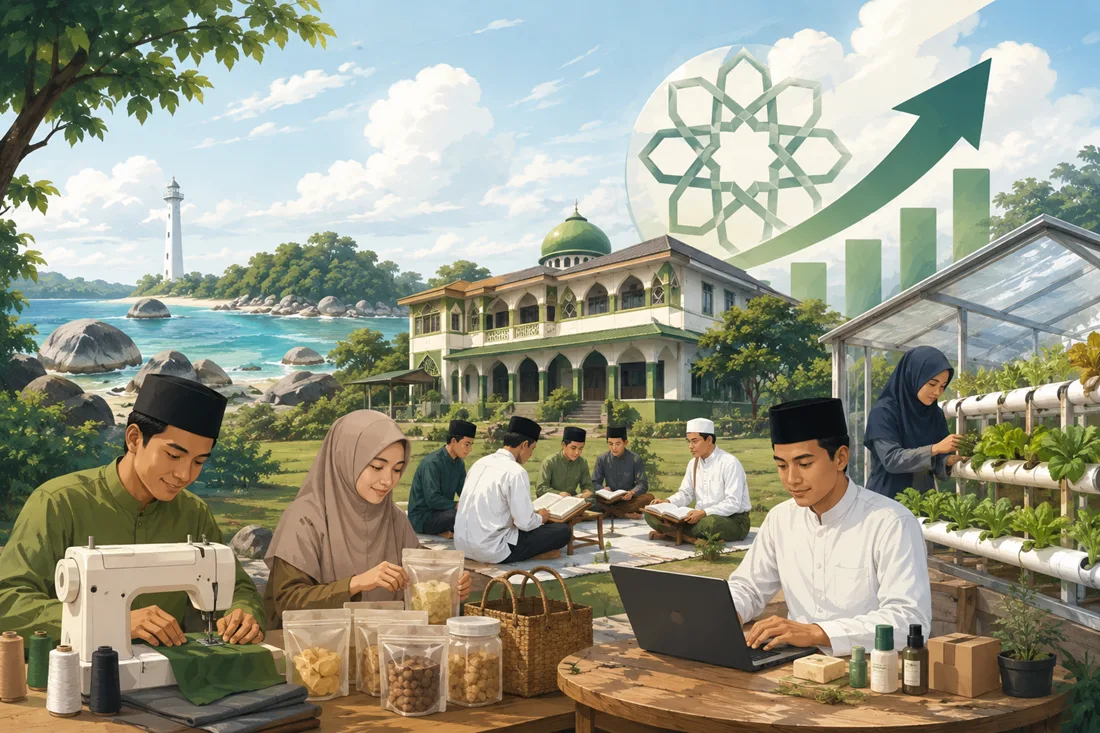
Jakarta — The Indonesian government's push to strengthen the national sharia economy is gaining momentum through grassroots initiatives. In Belitung Regency, the implementation of the One Pesantren One Product (OPOP) program has emerged as a strategic catalyst to foster economic self-reliance within traditional Islamic boarding schools (pesantrens) while simultaneously backing local tourism.
A comprehensive study conducted by researchers from Universitas Bangka Belitung (UBB)—Putra Pratama Saputra, Ryand Daddy Setyawan, and Muhammad Kurnia—reveals that while the OPOP program has been generally effective, critical structural refinements are still needed to optimize its long-term impact.
From Traditional Education to Economic Powerhouses
Historically viewed strictly as traditional centers for Islamic studies, pesantrens are undergoing a massive modern transformation. Today, they are balancing religious education with entrepreneurial skills to equip students (santri) for the digital era.
"With approximately 30,000 pesantrens and 4 million students nationwide, the economic potential of this sector is massive," the UBB research team noted, citing national sharia economy data.
In Belitung Regency—a region heavily anchoring its economy on UNESCO-recognized Geopark tourism—the OPOP program serves a dual purpose: driving institutional self-sufficiency and enriching the local tourism climate with indigenous brands. The study highlighted three prominent pesantrens near Tanjungpandan City that successfully spearheaded diverse business models under the program:
Fajrul Islam Buluh Tumbang: Established in 2020, this institution produces bottled drinking water branded as FI Water, operates FI Farm (growing Javanese chili and Kowi coffee), and even ventures into manufacturing mosque domes.
Baitul Qur'an: A dedicated female pesantren operating since 2013 that runs a knitted sewing business, generating an average cooperative income of IDR 20 million per month.
Madinah El Wihdah: Established in 2002, this school manages catfish production, chili plantations, and a specialized kelulut (stingless bee) honey farm, also pulling in around IDR 20 million monthly via its cooperative.
The Hurdles: Cooperative Status and Mismatched Internships
Despite these flourishing business units, the UBB researchers identified three critical operational gaps that the government and cooperative agencies must immediately address to enhance the program’s effectiveness:
1. Structural Ambiguity of Cooperatives
Currently, most pesantren cooperatives (kopontren) merely function as standalone business units directly subordinate to the school administration. To unlock their full potential, the study recommends transforming these cooperatives into separate legal entities that act as the primary umbrella or business center managing all underlying commercial activities.
2. Fragmented Marketing Networks
While internal sales thrive, broader market integration remains limited. The study stresses the necessity of intensifying media assistance and systematically involving major religious community organizations (such as Nahdlatul Ulama) alongside provincial MSME cooperative agencies to widen the marketing funnel.
3. The Training-Internship Mismatch
One of the most striking findings was the operational divergence during training phases. Due to differing management philosophies among pesantren founders, some institutions manage operations internally, while others hire external professionals. This has occasionally led to a mismatch between the pesantren's actual core business domain and the internship placements provided by program organizers.
A Blueprint for Sustainable Community Growth
To ensure the sustainability of the One Pesantren One Product initiative beyond initial government funding, the study calls for tighter cross-sector collaboration. Future government and private sector training programs must ensure rigid alignment with what each pesantren actually produces.
By bridging the gap between traditional management and modern corporate networks, Belitung's pesantrens are well on their way to becoming independent economic hubs, proving that spiritual devotion and financial self-reliance can seamlessly walk hand in hand.
Source: Saputra, P. P., Setyawan, R. D., & Kurnia, M. (2023). Analysis of the Effectiveness of the One Pesantren One Product (OPOP) Program in Supporting the Economic Empowerment of Islamic Boarding Schools in Belitung Regency. Society, 11(2), 543-556. https://doi.org/10.33019/society.v11i2.660#