
Breaking the Routine: How Bangka Belitung High Schools Fight 'Gadget Addiction' to Revive Student Literacy
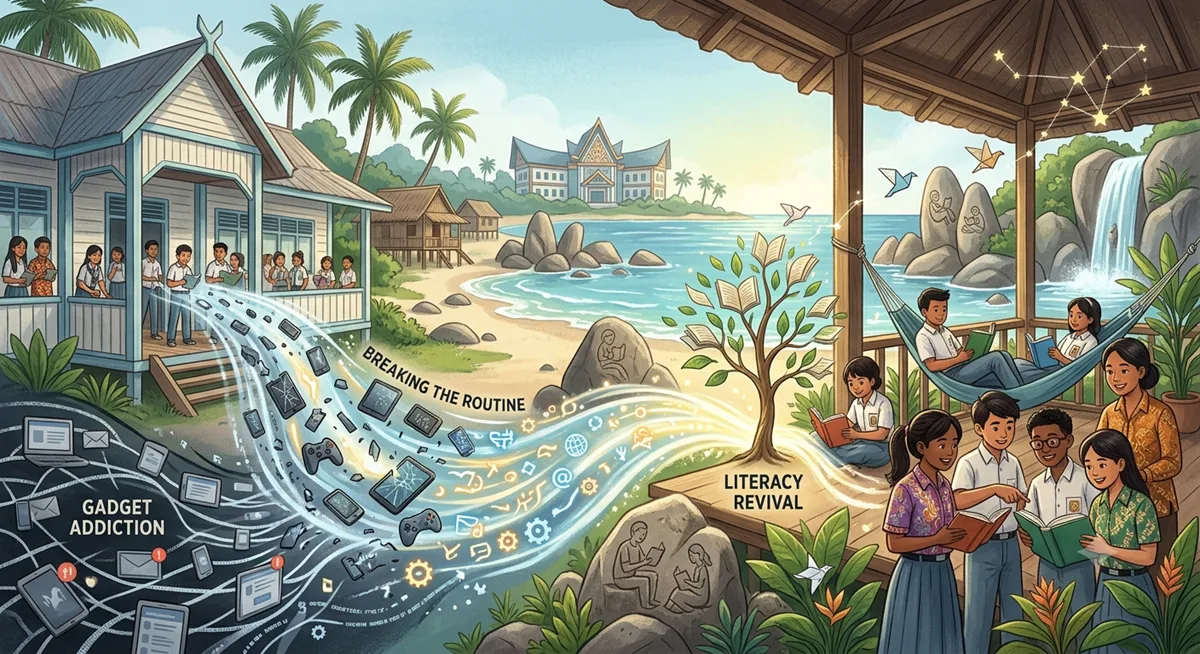
BANGKA – The School Literacy Movement (Gerakan Literasi Sekolah/GLS), which was launched nationally in 2015, faces a tough road in the post-pandemic era. In the archipelagic landscape of the Bangka Belitung Islands, educators are fighting an uphill battle against digital distractions, limited resources, and geographic isolation to instill a genuine reading culture among high school students.
A comprehensive study titled "Revitalizing the School Literacy Movement: Strategies for Strengthening Literacy Culture in Senior High Schools of Bangka Belitung Islands," published in the International Journal of Language Pedagogy (November 2025), sheds light on the stark realities of regional education. Conducted by researchers from Universitas Bangka Belitung and the University of Innsbruck, Austria, the qualitative descriptive study closely monitored eight senior high schools across the province between June and August 2025.
The Formality Trap vs. The Digital Seduction
For years, the provincial high schools have carried out national directives, such as the mandatory 15-minute morning reading sessions and the setup of classroom reading corners. However, observations and semi-structured interviews with 42 school participants—including principals, teachers, and students—reveal that these programs often end up being treated as a mere administrative formality.
"The biggest obstacle is building and maintaining reading motivation," the research team, led by M. Aries Taufiq, noted in the report.
Teachers uniformly expressed immense difficulty competing with the allure of smartphones. Students admitted they preferred spending their free time scrolling through social media platforms and engaging with their gadgets rather than opening a book, rendering short reading periods insufficient for developing deep reading habits.
The problem is deeply rooted in local socio-economic realities. In rural and coastal areas, high dropout rates and local cultural dynamics frequently push children to work in regional tin mining sectors instead of prioritizing formal education. Consequently, reading enthusiasm is highly unequal: the capital city of Pangkalpinang recorded a high reading index of 85.40, while South Bangka Regency lagged far behind at 62.22.
Archipelagic Disparities in Resource Distribution
Beyond student motivation, schools situated on smaller or more remote islands struggle under systemic barriers. The study highlighted severe geographical constraints, ranging from poor internet connectivity that derails digital literacy initiatives to an uneven distribution of printed books.
Funding instability further disrupts the continuity of the literacy movement. While schools like SMAN 1 Pangkalpinang and SMAN 1 Tanjung Pandan benefited from active principals who allocated School Operational Assistance (BOS) funds for new materials and literacy festivals, others suffered from shifting administrative priorities. At SMA 1 Koba, for example, the classroom reading corners completely collapsed after the COVID-19 pandemic due to a lack of sustained initiative and loose leadership.
Furthermore, many teachers lack professional training in literacy-based pedagogy, leading to surface-level activities rather than deep curriculum integration. In some instances, schools lacked basic operational facilities, such as functioning sound systems to broadcast literacy events.
Six Strategic Solutions for Revitalization
To move away from superficial compliance toward a sustainable literacy ecosystem, the study outlines a multi-level framework tailormade for archipelagic constraints:
Strengthening School-Community Partnerships: Forging strong ties with local governments and village libraries. For remote islands, deploying mobile libraries and community-driven reading networks can bridge access gaps.
Integrating Local Wisdom: Introducing contextual reading materials focused on Bangka Belitung’s rich maritime heritage and folklore to increase student engagement.
Enhancing Teachers' Literacy Competence: Training educators in advanced literacy pedagogy while running active teacher reading clubs to foster genuine role models.
Optimizing Digital Literacy Platforms: Merging traditional text with e-libraries and teaching students to critically evaluate online information.
Student Empowerment: Nurturing peer-led reading circles, debate clubs, and student-run journalism programs to transform students from passive participants into active leaders.
Strategic Leadership Support: Institutionalizing clear literacy success metrics directly into school planning, evaluation systems, and annual budgets.
The authors conclude that a successful school literacy culture cannot rely solely on generic national models. It must adapt flexibly to the geographic, economic, and digital realities of the region.
Source: Taufiq, M. A., Herza, Pangestu, F. A., Harianto, Jong, L. F., & Manalu, H. F. (2025). Revitalizing the school literacy movement: Strategies for strengthening literacy culture in senior high schools of Bangka Belitung Islands. International Journal of Language Pedagogy, 5(1), 12-24. https://doi.org/10.24036//ijolp.v5i2.129
Image Source: The cover image used for this article illustration was generated using Artificial Intelligence (Generative AI) technology.