
Combatting Hoaxes: How the Google Classroom-Assisted MULGRANING Model Boosts High Schoolers' Digital Literacy
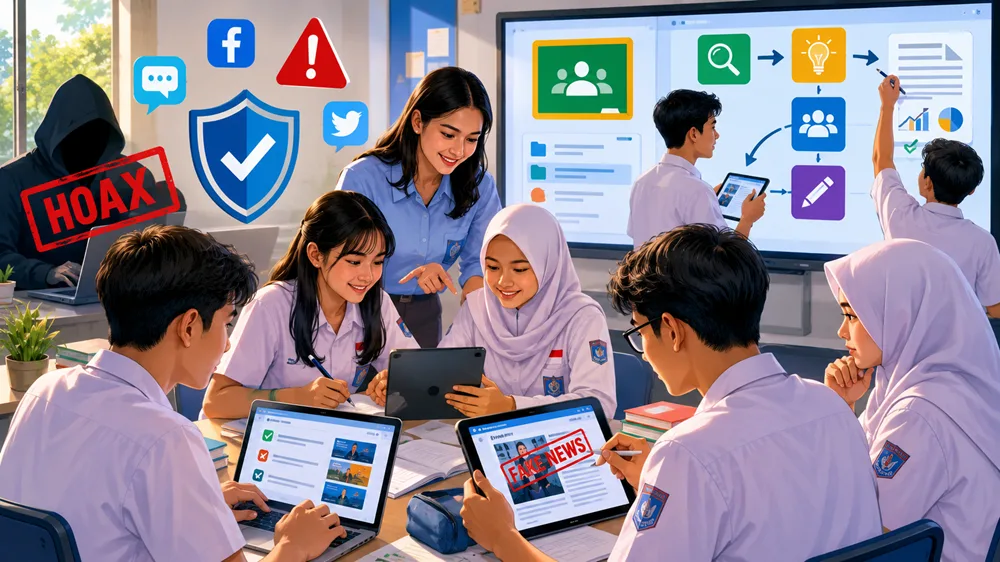
Jakarta – Rapid global advancements in digital technology have turned media and digital literacy into non-negotiable competencies in modern education. Amid the heavy circulation of complex online information, public high school students are frequently exposed to digital hoaxes and rampant disinformation.
To address this challenge, an international collaborative study has successfully tested a breakthrough learning model designed to transform how students process online information. Titled "The Effectiveness of the MULGRANING Model with Google Classroom for Enhancing Media and Digital Literacy," the study was published in Jurnal Educative: Journal of Educational Studies (December 2025).
The research was spearheaded by Vivi Indriyani from Universitas Negeri Padang, in collaboration with Jasmienti and M. Aries Taufiq from UIN Sjech M. Djamil Djambek Bukittinggi, Nofrahadi from the University of Bangka Belitung, and Herland Franley Manalu from the University of Innsbruck, Austria.
Using a descriptive quantitative approach from January to June 2025, the team tracked 68 eleventh-grade students from SMA Negeri 2 Padang and SMA Negeri 9 Padang to evaluate their literacy performances through structured, expert-validated observation metrics.
Weaponizing the Eight Steps of MULGRANING
The Multiliteracy Integrative Learning (MULGRANING) model offers an adaptive approach to teaching by requiring students to move away from being passive consumers and instead become active, critical content creators. When integrated into Indonesian language classes focused on parsing complex scientific texts, the model utilizes an interconnected eight-step syntax:
Experiencing: Students analyze real-world social phenomena or digital news via links posted on Google Classroom.
Conceptualizing: Learners collaborate asynchronously using Google Docs or Jamboard to map out scientific writing frameworks.
Analyzing: Small groups dissect multiple uploaded scientific texts, identifying structural similarities, differences, and credibility gaps via the comments section.
Producing & Creating: Peer groups co-author original scientific papers in real time.
Networking: Students upload drafts to Google Classroom to give and receive peer feedback.
Applying: The scientific texts are transformed into interactive digital projects, such as short campaign videos published on school media platforms.
Comparing: Synchronous and asynchronous digital debates are held to highlight the distinct strengths of each group's project.
Synthesizing: Students reflect on their text-processing journey by publishing digital learning journals.
"Google Classroom acts as a seamless digital ecosystem," the researchers noted, emphasizing how the platform's mobile accessibility allowed smooth execution of this intense pedagogical flow.
Empirical Results: Sharp Critical Eyes, Growing Management Skills
Following a rigorous eight-session cycle, descriptive statistical calculations revealed a strong positive shift in the students' digital behaviors. Overall, 38.24% of the students achieved a high literacy classification, 44.12% scored in the moderate tier, and only 17.64% remained low.
The study highlighted a fascinating divide across specific literacy dimensions:
| Core Literacy Indicator Assessed | Key Behavioral Metrics Tracked | Mean Experimental Score (Out of 100) | Performance Breakdown |
| Accessing & Evaluating Information | Spotting valid sources; filtering credible content from digital hoaxes. | 87.0 | Highest Achievement: Students successfully verified data reliability. |
| Creating Media Products | Utilizing appropriate digital tools; building multimodal video campaigns. | 82.0 | High-Good: Strong execution of creative digital expressions. |
| Analyzing Media Messages | Unpacking the underlying goals, bias, and ethics behind media construction. | 80.0 | Good: Solid conceptual comprehension of digital texts. |
| Using & Managing Information | Synthesizing diverse data; organizing insights using original language. | 79.0 | Moderate-Lowest: Students still struggled to transform raw data. |
Source: Quantitative Observation Analysis, Jurnal Educative (2025)
While students excelled at filtering out fake news (scoring up to 94 in selecting valid sources), their information management skills remained a bottleneck. The data proved that synthesizing large chunks of online data into original text requires higher-order cognitive skills that need prolonged academic guidance.
Infrastructure Gaps: A Tale of Two High Schools
The study exposed a notable performance gap driven by institutional differences. At SMA Negeri 2 Padang, a higher concentration of students landed in the "high" literacy tier. Conversely, the majority at SMA Negeri 9 Padang scored within the "moderate" category.
The research team linked this directly to school-level digital readiness. SMA Negeri 2 Padang benefited from reliable high-speed internet infrastructure and high hardware availability, boosting consistent student engagement. Meanwhile, SMA Negeri 9 Padang faced unstable connectivity and limited digital resources, which hampered the complex processing tasks required by the MULGRANING model.
"Digital literacy outcomes are not shaped by pedagogical theory alone; they are heavily dependent on contextual, environmental, and infrastructure factors," the authors stated.
Policy Implications for 21st Century Classrooms
The empirical success of the Google Classroom-assisted MULGRANING framework provides an actionable blueprint for modern educational reform:
For Educators: Language instruction must shift from passive reading to active, technology-driven content creation. Teachers should serve as digital guides, scaffolding how students organize and apply information rather than simply retrieving it.
For School Administrations: Enhancing digital literacy requires building robust institutional ecosystems, including stable internet connections, uniform hardware availability, and ongoing professional development for teachers.
For Policymakers: Structured, multiliteracies-oriented instructional models should be formally integrated into national curricula to proactively shield younger generations from digital misinformation.