
The Shield of Shiny Metal: How the Trump Trade War Cemented Gold’s Safe-Haven Status
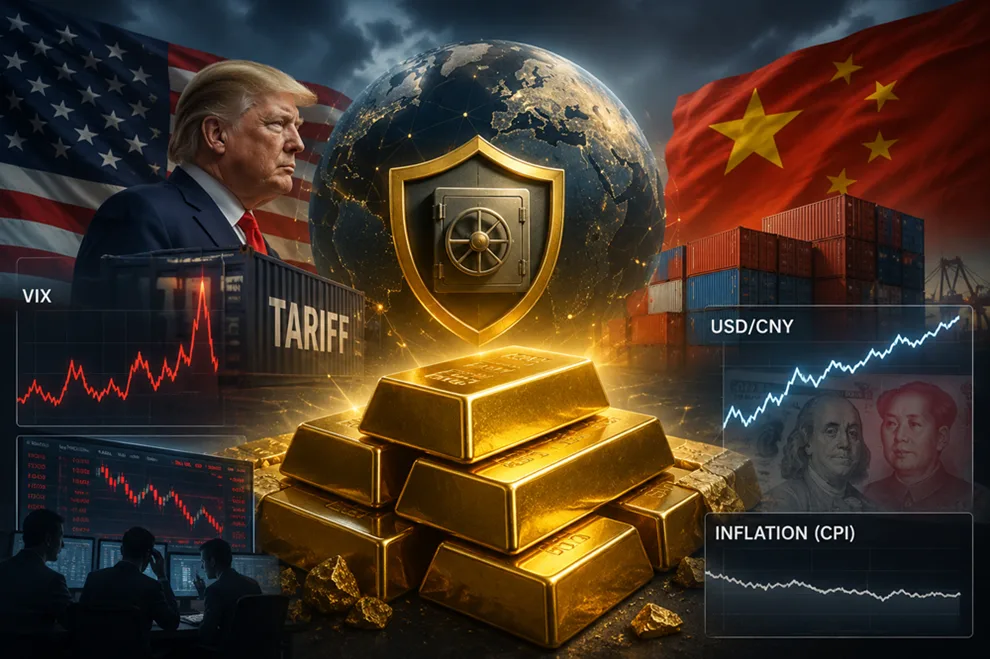
Jakarta – When political and economic turbulence rattles global financial stability, institutional investors frequently abandon equities and scramble for defensive assets. This "flight-to-quality" psychological phenomenon was explicitly demonstrated during the administration of U.S. President Donald Trump (2017–2021), whose protectionist trade barriers triggered deep diplomatic friction and intense market panic.
A collaborative study titled "The Role of Gold as a Safe-Haven Asset amid Diplomatic Turmoil and The Trump Trade War" maps out how global risk factors dictated the price of the precious metal during this volatile era. Published in the Proceedings of the 2nd International Conference of Economics, Management, Accounting, and Business Digital (ICEMAB 2025), the empirical research was co-authored by Wawan Irawan from the Ural Federal University alongside Wenni Anggita, Yanto Yanto, Ariandi A. Zulkarnain, and M. Afdal S. from the University of Bangka Belitung.
By running ordinary least squares (OLS) multiple linear regression analysis on time-series data from January 2016 to December 2022, the academic team confirmed that diplomatic friction and stock market panic are far more potent drivers of global gold prices than traditional macroeconomic factors like consumer inflation.
The Trump Protectionist Effect on Precious Metals
Under the core banner of the "America First" principle, the Trump administration engineered sweeping transformations in international trade dynamics by slapping punitive import tariffs on massive economies—most notably China, but also affecting Canada, Mexico, and the European Union. The resulting U.S.–China trade war, which erupted in full force in July 2018, severely disrupted global manufacturing pipelines and sent institutional shockwaves through standard equity markets.
According to the study's empirical model, this trade friction had a direct, statistically significant positive effect on global gold prices. By utilizing a specific "Trade War Dummy" variable (coded 0 for the pre-conflict period and 1 for the peak confrontation era), the researchers discovered that the onset of the trade war independently pushed the baseline value of gold up by 0.487 units.
"The high-intensity political tensions and widespread media coverage during the U.S.–China trade war fundamentally solidified investor perception of gold as a critical protective instrument," the researchers explained. While the initial surge between 2018 and 2019 was directly tied to the escalating tariffs, the upward price momentum persisted throughout the conflict, eventually blending into the Federal Reserve’s massive monetary stimulus programs during the 2020 COVID-19 pandemic.
Fear Indices and Currency Risks Drive the Market
The study closely analyzed market psychology using the Chicago Board Options Exchange (CBOE) Volatility Index, popularly known as the VIX or the "fear index". The regression results proved that stock market volatility has an incredibly strong positive correlation with gold $(p < 0.01)$.
When global indices like the S&P 500 fluctuated wildly due to unstable tariff negotiations, the VIX spiked, signaling heightened investor anxiety. The model shows that a single-unit increase in the VIX index corresponded to a 0.312-unit rise in global gold prices, as portfolio managers aggressively rotated out of risky equities to park capital in zero-default safe assets.
| Explanatory Variable | Regression Coefficient | Statistical Significance (p-value) | Market Impact Breakdown |
| Trade War Dummy (TWD) | +0.487 | 0.001 (Highly Significant) | Tariffs and diplomatic standoff drove systematic wealth preservation. |
| Stock Market Volatility (VIX) | +0.312 | 0.000 (Highly Significant) | Spikes in the "fear index" triggered rapid defensive equity liquidation. |
| USD/CNY Exchange Rate | +0.276 | 0.009 (Significant) | Chinese Yuan depreciation led to massive regional hedging via gold. |
| U.S. Inflation (CPI) | +0.159 | 0.058 (Not Significant) | Stable global prices weakened gold's traditional role as a consumer hedge. |
Source: Ordinary Least Squares (OLS) Regression Data, ICEMAB 2025
Model Diagnostics: $R^2 = 0.721$, Adjusted $R^2 = 0.702$, Overall F-statistic = 18.94 $(p = 0.000)$
Simultaneously, the research shed light on the vital role of the USD/CNY exchange rate. Because global gold is priced and settled in greenbacks, fluctuations in major currencies alter purchasing power. When the Chinese Yuan depreciated against the U.S. Dollar due to heavy trade restrictions, the regression coefficient rose by 0.276. This meant that as the Yuan weakened, both mainland Chinese and international investors aggressively bought gold to hedge against local currency devaluation and shield their portfolios from currency contagion.
The Diminishing Role of Gold as an Inflation Hedge
Interestingly, the study provided a surprising revelation regarding traditional financial theory: Inflation (CPI) had no statistically significant impact on gold prices during the 2016–2022 observation window $(p = 0.058)$.
This deviation from classic economic textbooks, which historically view gold primarily as a long-term inflation hedge, occurred because global consumer inflation remained exceptionally stable and well under 3% for the majority of the Trump presidency. Without the threat of runaway consumer price hyperinflation, the incentive to buy gold simply to preserve everyday purchasing power dropped significantly. Instead, investors treated gold almost entirely as a financialized geopolitical shield to guard against sudden policy decisions, trade blockades, and systemic market drops.
Strategic Roadmap for Global Investors and Governments
The empirical conclusions reached by Wawan Irawan and the University of Bangka Belitung team present crucial policy implications for modern risk management:
For Institutional Investors: Gold must remain a permanent, non-negotiable core element of multi-asset portfolios, particularly during active trade altercations, since its zero-correlation behavior protects general capital when stock indices crash.
For Central Banks and Governments: State financial authorities must anticipate how global protectionist trade wars shock domestic currency stability. Central banks are advised to maintain robust foreign exchange and gold reserves to backstop domestic markets during international diplomatic standoffs.
For the General Public: Financial literacy initiatives should be expanded to teach retail consumers that physical gold is not merely a decorative ornament, but a structural value-preserving asset designed to insulate personal net worth from external macroeconomic storms.
Moving forward, the authors recommend that future econometric models incorporate advanced tools like the Vector Error Correction Model (VECM) and introduce complementary variables—such as Federal Reserve interest rate hikes and global economic policy uncertainty indices—to track the evolving complexities of international geopolitical conflicts.
Source: Irawan, W., Anggita, W., Yanto, Y., Zulkarnain, A. A., & S, M. A. (2025). The role of gold as a safe-haven asset amid diplomatic turmoil and the Trump trade war. Dalam M. H. Basri & Y. Yanto (Eds.), Proceedings of the 2nd International Conference of Economics, Management, Accounting, and Business Digital (ICEMAB 2025), Advances in Economics, Business and Management Research (Vol. 366, hlm. 156-162). Atlantis Press. https://doi.org/10.2991/978-94-6463-974-2_23