
Fragile Legal Institutions Seen as Failing to Protect Communities Amid Palm Oil Expansion
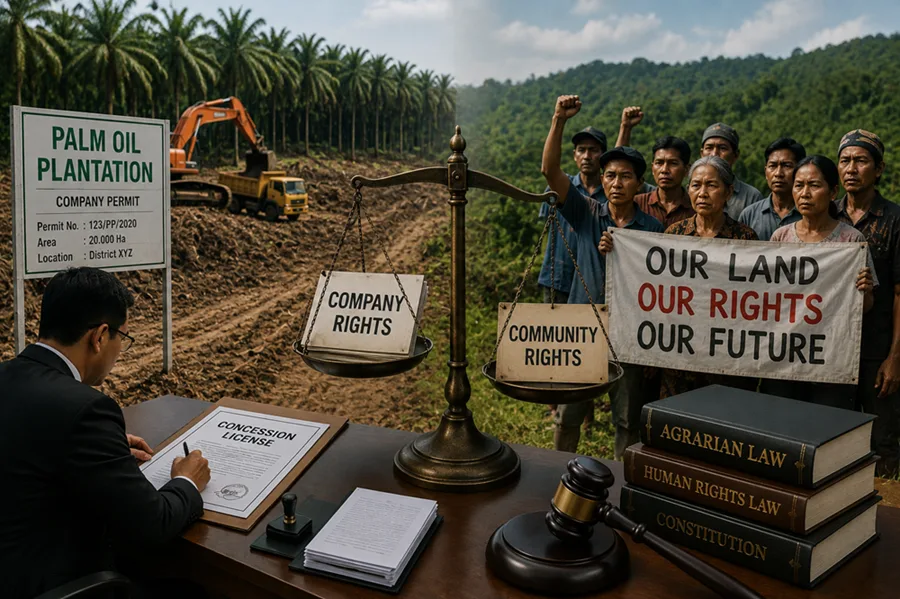
JAKARTA — The rapid expansion of palm oil plantations in Indonesia continues to raise concerns over the protection of local community rights. A recent study by researchers from Universitas Bangka Belitung found that weak legal institutions remain a major factor behind agrarian conflicts in plantation areas.
The study, published in the International Journal of Social and Education (INJOSEDU), was conducted by Tiara Ramadhani, Khalid Vikriadi, and Riky Ovaliansyah Harahap. Using a socio-legal approach, the researchers carried out in-depth interviews, field observations, and document analysis in regions with high levels of palm oil-related conflicts, including West Kalimantan, Central Kalimantan, and Riau.
The findings show that palm oil expansion has created structural inequalities in access to land and natural resources for local communities. Many residents reportedly lost customary land because they lacked formal land certificates, while concession permits were often issued without meaningful consultation with affected communities.
“The process of company entry was perceived as coming ‘from above,’ beginning with concession permits issued without meaningful consultation,” the researchers wrote in the report.
The study also highlighted the limited role of formal institutions such as the National Land Agency (BPN), local governments, and the courts in resolving agrarian disputes. BPN was described as slow in addressing overlapping land claims, while concession map verification processes were considered opaque and lacking transparency.
Local governments, meanwhile, were viewed as prioritizing investment and corporate interests over community protection. Court proceedings were described as costly, time-consuming, and often disconnected from the social context and historical land tenure claims of local residents.
The research further found that non-state mechanisms such as the Roundtable on Sustainable Palm Oil (RSPO) and the Indonesian Sustainable Palm Oil (ISPO) certification system have yet to provide effective protection for affected communities. RSPO mechanisms were considered difficult to access due to complex documentation requirements and the need for strong advocacy capacity, while ISPO was criticized for focusing more on administrative compliance than substantive community rights protection.
According to the researchers, the core issue lies not in the absence of regulations, but in the weak performance of legal institutions responsible for implementing, supervising, and enforcing the law. They recommended institutional reforms aimed at strengthening the capacity of BPN, local governments, and law enforcement agencies in handling land disputes.
The study also called for the establishment of independent mediation bodies at the provincial or district level to ensure that agrarian conflict resolution is faster, more professional, and more equitable for both communities and companies.
Source: Ramadhani, T., Vikriadi, K., & Harahap, R. O. (2025). The role of legal institutions in protecting community rights amid palm oil plantation growth. International Journal of Social and Education (INJOSEDU), 2(9), 2607–2615.