
Study Compares Media Control in Indonesia and Saudi Arabia
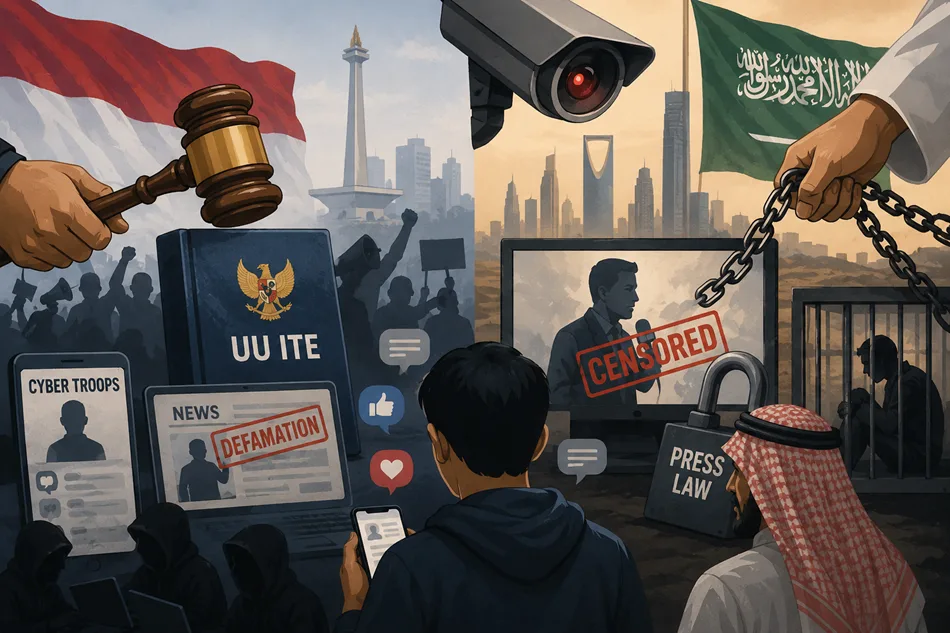
Jakarta – A recent comparative study has found that Indonesia and Saudi Arabia employ different models of media control despite both using the media as a political instrument to shape public discourse and maintain state authority.
The study, conducted by researchers from Universitas Bangka Belitung, examined media systems in the world’s largest Muslim-majority democracy and one of the Middle East’s most restrictive monarchies. The paper was published in the Journal of Society Innovation and Development Volume 7 Number 2 in 2026.
Researchers Khalid Vikriadi, Ainiyatul Latifa, Riky Ovaliansyah Harahap, Tiara Ramadhani, Aubaidillah Doloh, and Nurul Kamaly concluded that Indonesia operates under what they described as “competitive digital manipulation,” while Saudi Arabia relies on “legal-institutional control.”
According to the study, Indonesia’s media environment remains relatively open compared with Saudi Arabia, but democratic institutions alone do not guarantee full press freedom. Researchers argued that restrictive digital regulations and coordinated online propaganda increasingly threaten civil liberties in Indonesia.
The paper identified Indonesia’s Information and Electronic Transactions Law, commonly known as the ITE Law, as one of the main legal instruments frequently used to suppress criticism and digital expression. Researchers stated that Article 27 of the law, which regulates online defamation, has often been used against journalists, activists, and ordinary citizens.
One of the cases highlighted in the study involved Baiq Nuril Maknun, a teacher who was prosecuted after recording alleged verbal sexual harassment by her superior. Researchers described the case as an example of how digital regulations can create a chilling effect and encourage self-censorship.
Beyond legal pressure, the study also pointed to the growing role of “cybertroops,” organized digital groups allegedly mobilized to manipulate public opinion on social media platforms. According to the researchers, such groups are often used to amplify pro-government narratives while marginalizing critical voices online.
The paper cited the 2024 ranking by Reporters Without Borders, which placed Indonesia 108th globally in press freedom and categorized the country as “partly free” due to persistent legal and digital pressures.
In contrast, Saudi Arabia was described as implementing a far more centralized and repressive media system under the monarchy’s absolute authority. Researchers stated that Article 39 of Saudi Arabia’s 1992 Basic Law of Governance explicitly requires media outlets to support state unity and prohibits content deemed capable of causing division or dissent.
The study argued that Saudi authorities maintain media control through extensive surveillance, strict censorship, and severe punishment for dissenting voices. One example discussed was the 2018 killing of Saudi journalist Jamal Khashoggi at the Saudi consulate in Istanbul, which researchers described as evidence of the extreme risks faced by critical journalists.
According to the paper, Saudi Arabia ranked 166th globally in the 2024 World Press Freedom Index and remains categorized as a “not free” media environment.
The study also highlighted differences in civil society freedoms between the two countries. While peaceful protests and advocacy movements still occur in Indonesia despite legal risks, Saudi Arabia continues to prohibit freedom of assembly and tightly restrict political activism.
Researchers noted, however, that digital platforms have slightly disrupted traditional information monopolies in Saudi Arabia. Campaigns such as the #Women2Drive movement demonstrated how social media could pressure authorities to reconsider restrictive policies, including the former ban on women driving.
The paper concluded that the structure of digital legal systems is now a more accurate indicator of press freedom than formal democratic labels alone. Researchers warned that democracies may still experience declining civil liberties when digital laws are used to suppress dissent and manipulate online discourse.
The study recommended reforming Indonesia’s ITE Law to prevent misuse against journalists and civil society groups, while also calling for stronger international monitoring of digital repression practices in both democratic and authoritarian states.
Source: Vikriadi, K., Latifa, A., Harahap, R. O., Ramadhani, T., Doloh, A., & Kamaly, N. (2026). Media control in Indonesia and Saudi Arabia: A comparative study of digital governance and press freedom. Journal of Society Innovation and Development, 7(2), 461–469. https://doi.org/10.63924/jsid.v7i2.288