
Study Finds Indonesian Spelling Errors Still Common in Public Spaces Across Pangkalpinang
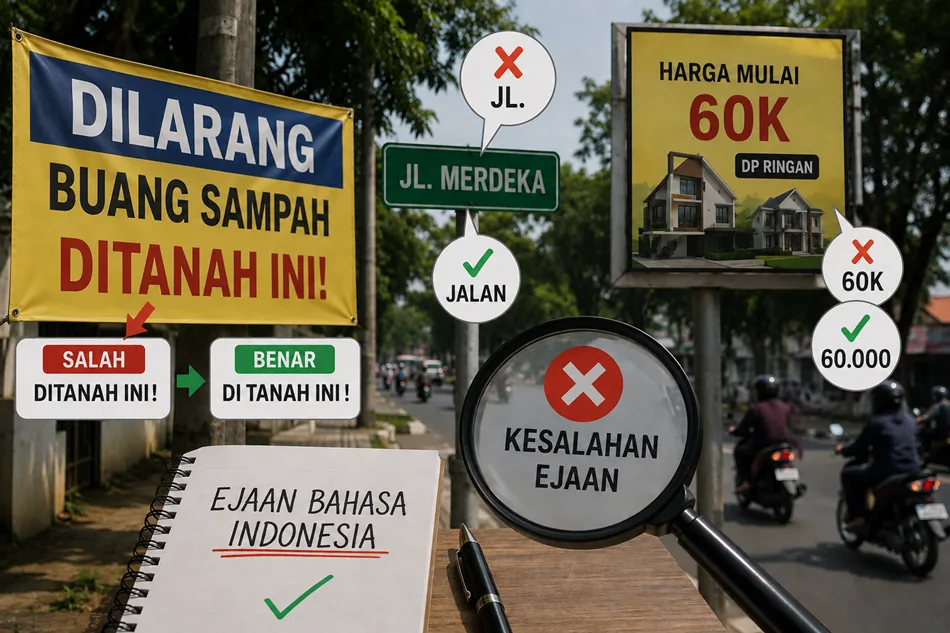
Pangkalpinang – A recent study conducted by researchers from Universitas Bangka Belitung found that spelling and language errors in public signs across Pangkalpinang City remain widespread, potentially affecting public understanding and the city’s visual image.
The research, titled Errors in the Use of Indonesian Spelling in Writing Open Spaces in the City of Pangkalpinang, Bangka Belitung, was conducted by Lasmi Hartati and Hakim Prasasti Lubis and published in the September 2025 edition of the Jurnal Pembelajaran Bahasa dan Sastra.
Researchers observed numerous spelling mistakes on banners, billboards, signboards, and public information displays throughout Pangkalpinang. According to the study, the errors included incorrect punctuation, misuse of capital letters, improper abbreviations, inaccurate prepositions, and inconsistent use of foreign terms.
The paper explained that Indonesian language regulations require the proper use of Bahasa Indonesia in public spaces, including on road signs, public facilities, banners, and other information media.
One example highlighted in the research involved warning banners that incorrectly separated Indonesian particles such as “-lah” from preceding words. Researchers noted that phrases such as “Laknat Lah” should instead be written as “Laknatlah” in accordance with Indonesian spelling rules.
Another commonly identified mistake involved the incorrect use of prepositions such as “di,” which were often written together with the following word instead of separately. The study also found excessive use of exclamation marks on warning signs and public notices.
Researchers further documented errors involving the use of foreign words such as check-in, check-out, and camping without italic formatting, as well as mistakes in abbreviations like “wib,” which should be written as “WIB” according to official spelling guidelines.
The study also pointed to incorrect spelling of official titles, names, and road information displayed on public banners and advertisements. Some signs were found to use all capital letters inconsistently or abbreviate words such as “Jalan” into “JL,” which researchers said does not conform to official Indonesian language standards.
According to the research, many residents appeared unaware of the errors because the intended meaning could still be understood. The paper cited findings showing that approximately 78 percent of the public did not recognize several incorrect spellings found in public spaces.
Researchers identified several factors contributing to the persistence of language errors, including limited public understanding of Indonesian spelling rules, weak language awareness, low motivation to apply proper language standards, and minimal legal enforcement regarding language regulations in public spaces.
The paper warned that continued misuse of Indonesian in public areas could gradually weaken respect for the national language and reduce the quality of public communication. Researchers also argued that poor spelling practices may affect the city’s aesthetic appearance and institutional credibility.
The study concluded that stronger supervision, public education, and language standardization efforts are needed to improve the use of Bahasa Indonesia in public spaces. Researchers called on local governments, business owners, and public sign managers to pay greater attention to proper language usage as part of preserving Indonesia’s national identity.
Source: Hartati, L., & Lubis, H. P. (2025). Errors in the use of Indonesian spelling in writing open spaces in the city of Pangkalpinang, Bangka Belitung. Jurnal Pembelajaran Bahasa dan Sastra, 4(5), 1315–1326. https://doi.org/10.55909/jpbs.v4i5.926