
Study Warns Trump’s Trade Policies Could Pressure Indonesia’s Economy
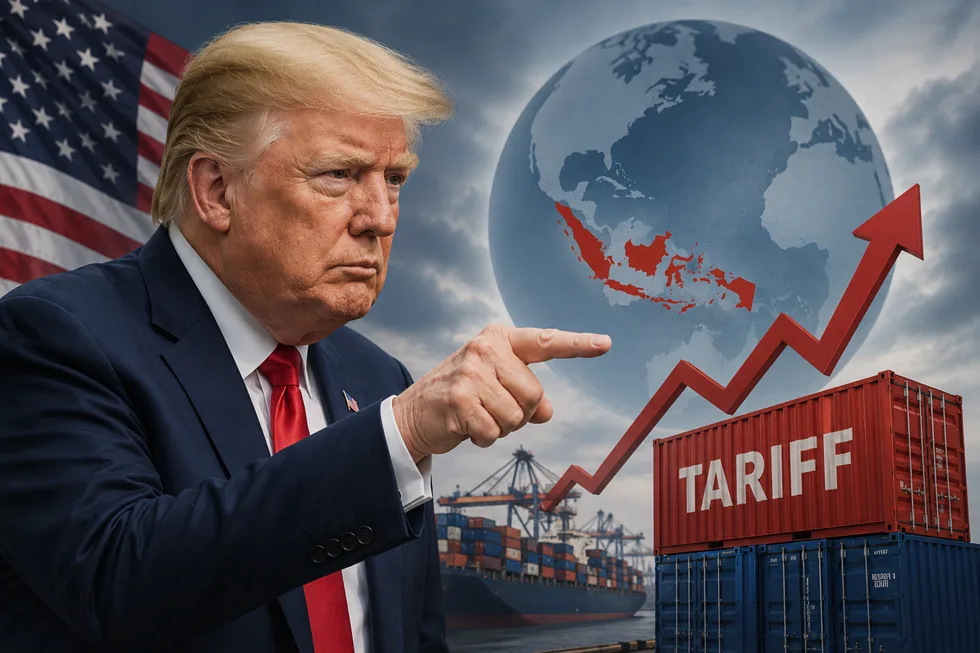
Jakarta – A recent study by researchers from Universitas Bangka Belitung warns that Donald Trump’s proposed trade and foreign policies for the 2024–2025 period could place significant pressure on Indonesia’s export sector, economic stability, and strategic position in the Indo-Pacific region.
The study, titled The Impact of Donald J. Trump’s Egocentric Policies on Indonesia: A Neorealist Analysis (Case Study: The 2024–2025 Trade War), was written by Yudi Septiawan, Jamal Din Aulia, Muhammad Amir Yusuf, and Endah Kurniati. The paper was published in the 2025 edition of the Indonesian Journal of Global Discourse.
Researchers argued that Trump’s “America First” approach reflects an egocentric and protectionist policy orientation prioritizing U.S. domestic interests, often at the expense of trading partners such as Indonesia.
According to the study, Indonesia remains highly vulnerable to shifts in U.S. trade policy because the United States is one of Indonesia’s largest non-Asian trading partners, particularly in textiles, electronics, footwear, rubber, agricultural products, and palm oil derivatives.
The paper highlighted concerns over the possible tightening of reciprocal tariffs and a review of Indonesia’s eligibility under the U.S. Generalized System of Preferences (GSP), a trade facility that grants lower tariffs for products from developing countries. Researchers warned that losing GSP privileges could make Indonesian products less competitive in the American market.
The study stated that higher tariffs on Indonesian exports could reduce export volume, weaken trade revenues, and place additional pressure on manufacturing industries that rely heavily on U.S. demand.
Researchers also noted that Trump’s trade policies could intensify geopolitical competition in the Indo-Pacific region. The United States was described as increasingly pressuring partner countries, including Indonesia, to align more closely with U.S. economic and defense interests amid its rivalry with China.
In the defense sector, the study found that Washington may encourage Indonesia to increase purchases of U.S. military equipment and expand defense cooperation. Failure to comply, researchers argued, could potentially affect Indonesia’s trade access and investment relations with the United States.
The paper further explained that Indonesia has adopted a “soft-balancing” strategy in response to pressures from major powers. Rather than confronting the United States directly, Indonesia has pursued economic diplomacy through ASEAN, the G20, and trade diversification toward markets in the Middle East, Africa, Japan, South Korea, and Europe.
Using a neorealist framework developed by international relations scholar Kenneth Waltz, the researchers argued that Indonesia’s actions reflect rational efforts by a middle power seeking to preserve sovereignty and economic stability in an international system dominated by major powers.
The study concluded that Trump’s reciprocal tariff policies are part of a broader U.S. strategy to maintain global economic dominance and counter the rise of competing powers such as China. In that context, Indonesia is viewed as strategically important but economically vulnerable due to its dependence on major export markets.
Researchers recommended that Indonesia strengthen economic diversification, expand diplomatic cooperation, and maintain strategic autonomy to reduce dependence on any single global power.
Source: Septiawan, Y., Aulia, J. D., Yusuf, M. A., & Kurniati, E. (2025). The impact of Donald J. Trump’s egocentric policies on Indonesia: A neorealist analysis (Case study: The 2024–2025 trade war). Indonesian Journal of Global Discourse, 7(2), 17–28.