
Study Highlights Women’s Role in Informal Offshore Tin Mining in Bangka
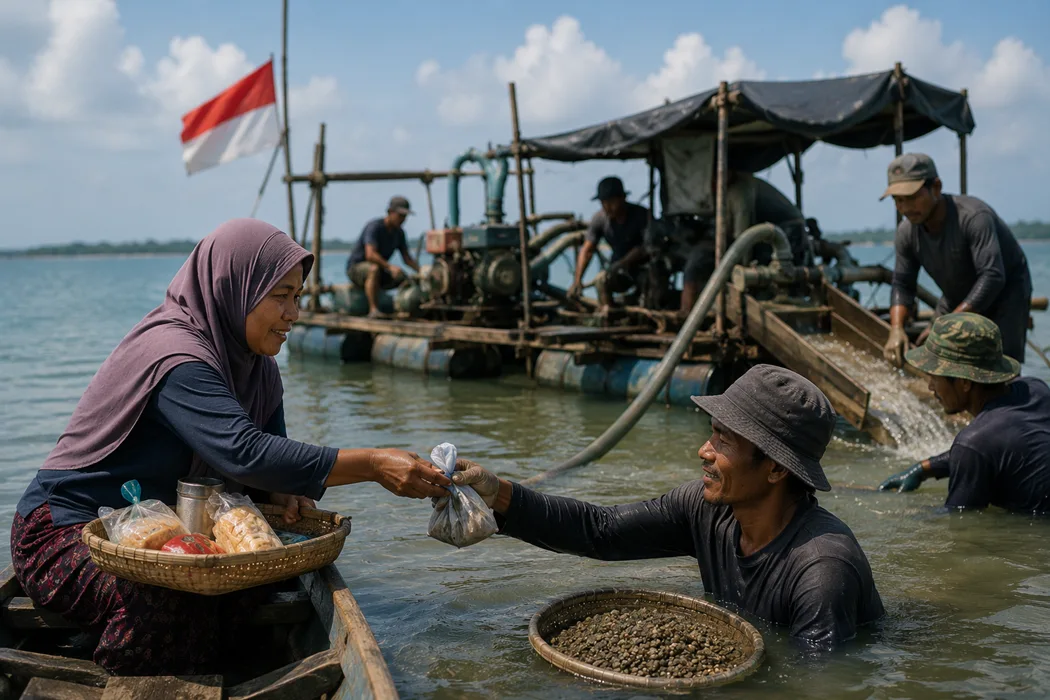
Pangkalpinang – A recent study by researchers from Universitas Bangka Belitung has shed light on the growing involvement of women in offshore tin mining activities in Belo Laut Village, West Bangka Regency, revealing the economic pressures, gender challenges, and social stigma faced by women working in the informal sector.
The study, published in Muwazah: Jurnal Kajian Gender in 2025, examined the phenomenon of women participating in marine mining activities through a local practice known as ngereman. Rather than working directly as miners, women barter food and daily necessities with miners in exchange for tin or request a share of mining proceeds.
Researchers found that economic hardship was the main factor driving women into the mining environment. Many women involved in ngereman are widows, elderly women, or mothers seeking additional income to support household needs and children’s education.
According to the paper, offshore tin mining in Bangka Belitung has traditionally been viewed as a masculine occupation associated with physical strength, courage, and endurance. The participation of women in the sector therefore challenges long-standing patriarchal norms within coastal communities.
The researchers used the theory of “hegemonic masculinity” developed by sociologist R. W. Connell to analyze how gender hierarchies shape women’s experiences in mining areas. The study argues that although women contribute significantly to household economies, their labor is often undervalued and treated as secondary compared to men’s work.
The paper also documented a range of risks faced by women in mining sites, including poor environmental conditions, exposure to polluted seawater and fuel substances, workplace accidents, and limited access to protective equipment.
In addition, women involved in ngereman reported experiencing verbal and non-verbal sexual harassment in the male-dominated mining environment. Researchers noted that inappropriate comments, gestures, and unwanted physical contact remain common due to weak oversight and the absence of formal workplace protections.
Despite these challenges, local perceptions toward women’s participation remain mixed. Some residents view ngereman as a long-standing cultural tradition and a legitimate economic adaptation to difficult living conditions. Miners and local transport operators interviewed in the study said women’s presence often helps sustain informal trade around offshore mining sites.
The researchers concluded that current regulations do not adequately recognize or protect women working in informal mining activities. They called on local governments to introduce gender-based empowerment programs, improve safety protections, and formally acknowledge women’s economic contributions in coastal mining communities.
Source: Juanda, R., Okta, N., Espiana, S., Putra, A., & Septia, R. (2025). Analysis of women’s involvement in marine mining: Motivation, challenges, and perceptions of the local community of Belo Laut Village Mentok District West Bangka Regency. Muwazah: Jurnal Kajian Gender, 17(1), 69–83. https://doi.org/10.28918/muwazah.v17i1.10183