
Researchers Examine the Meaning Behind Bangka Malay Taboo Expressions
Pangkalpinang – A recent linguistic study has revealed that taboo expressions in the Bangka Malay community are not merely myths or superstitions, but function as cultural tools to shape behavior, preserve ethics, and communicate social values across generations.
The research, conducted by I Nyoman Pasek Darmawa, Muhammad Rozani, and M Afifulloh, was published in the 2025 edition of English Review: Journal of English Education.
The study analyzed 39 taboo expressions commonly used in Bangka Malay society and grouped them into five categories: taboos for children, adults, pregnant women, culinary activities, and ethics. Researchers argued that the expressions remain influential because they combine cultural beliefs with strong emotional and cognitive effects.
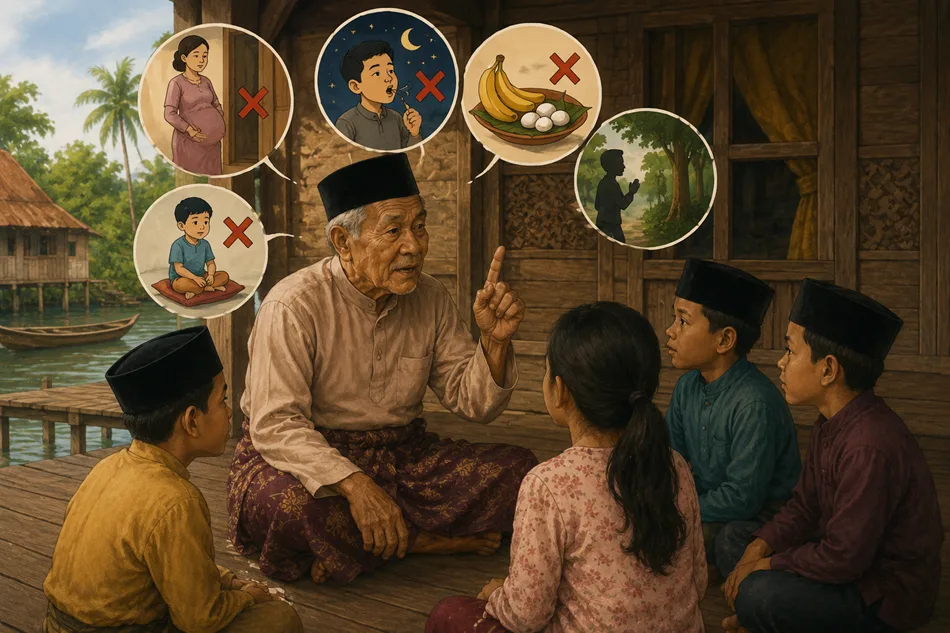
One of the expressions highlighted in the study warns pregnant women not to stand in doorways because it is believed to complicate childbirth. Researchers explained that the phrase symbolically links blocked passageways with difficulties during labor, making the warning easier for listeners to understand and remember.
Another widely known taboo discourages people from refusing food or drinks offered by others, a belief locally known as kepunan or kepon. In Bangka Malay culture, rejecting food is believed to invite misfortune, including accidents or injuries. Researchers noted that the tradition remains deeply rooted in local customs despite lacking scientific explanation.
The paper also documented taboos surrounding fishing activities. Carrying bananas or eggs while fishing is considered forbidden because it is believed to attract danger or supernatural disturbances. According to local customary leaders cited in the study, the taboo emerged from older beliefs that strong food odors could attract wild animals in forests and rivers.
Another common expression advises people not to whistle at night because it may “invite unseen beings.” Researchers said the warning may have originated from practical concerns in earlier settlements, where nighttime whistling disturbed neighbors or exposed hidden locations during colonial periods.
The study further explored how taboo expressions are used to teach ethics to children. One example warns children not to sit on pillows or they would develop ulcers. According to the researchers, the frightening consequence serves as a symbolic way to teach children respect for objects associated with the head, which is culturally regarded as sacred.
Researchers also found that many taboo expressions are closely tied to environmental ethics and traditional spirituality. In rural Bangka communities, people entering forests are encouraged to perform neratap, a ritual asking permission from spiritual guardians believed to protect the land.
Using Sperber and Wilson’s Relevance Theory, the study concluded that taboo expressions survive because they create strong psychological impressions that are easy to process and remember. Fear-based phrases, references to illness, and supernatural imagery were found to strengthen the effectiveness of oral communication in everyday life.
The researchers concluded that Bangka Malay taboo language continues to function as an important form of local wisdom, preserving moral values, social discipline, and cultural identity amid modern social change.