
Waste Mismanagement Crisis in Pagarawan Bangka: 500 Kg of Daily Trash Left Unmanaged, Research Calls for 3R Community Empowerment
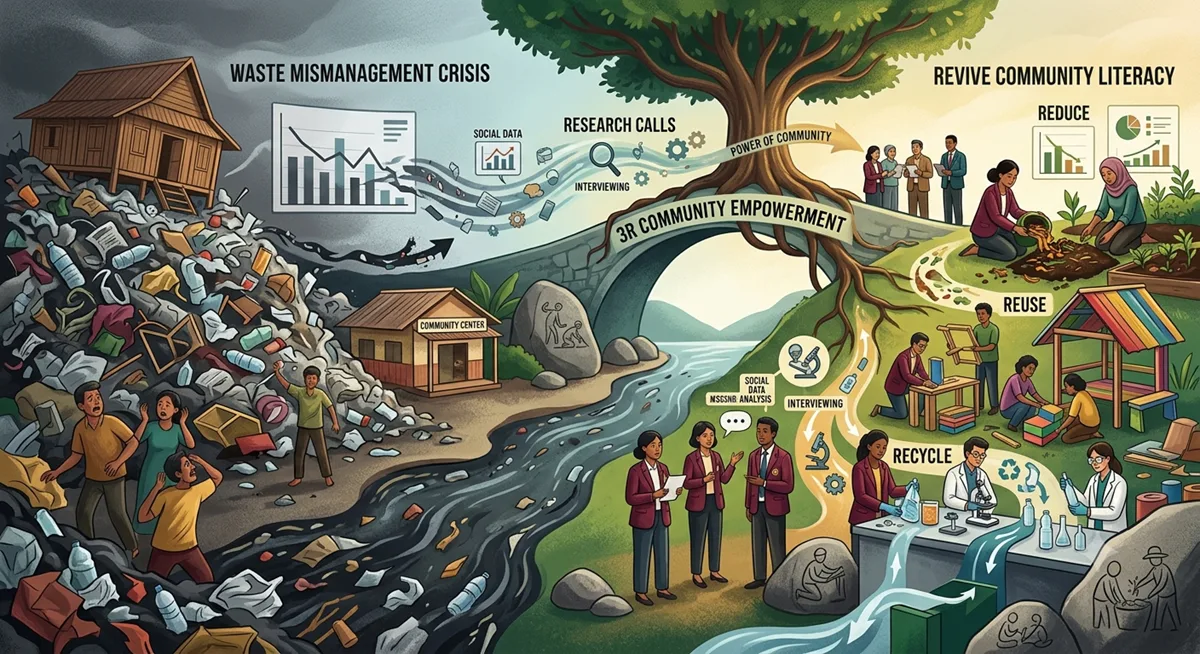
BANGKA – Amidst rapid population growth driven by both birth rates and transmigration, Desa Pagarawan in Bangka is facing a severe waste mismanagement crisis. A recent study highlights that the village produces approximately 500 kilograms of household waste every single day, which accounts for 98% of the total waste generated in the area.
The alarming data was published in the IOP Conference Series: Earth and Environmental Science (2021) in a research paper titled "Empowering Society in Waste Management System with the Reduce Reuse and Recycle Approach in Pagarawan Bangka". The study was conducted by an interdisciplinary team of researchers from Universitas Bangka Belitung: Sujadmi and Laila Hayati from the Department of Sociology, alongside R. A. Saputri from the Department of Political Science.
The findings reveal a stark reality: despite various efforts by the village government, environmental pollution and poor waste habits persist, threatening public health and degrading the local environment.
The Failure of Current Waste Mitigation Practices
According to the study, the waste management system in Desa Pagarawan remains entirely downstream-oriented. The local village-owned enterprise (Badan Usaha Milik Desa/BUMDes) merely picks up unsegregated trash from residential homes and dumps it directly into the final waste disposal site without any efforts to process it into value-added products.
This institutional limitation has worsened public behavior. The researchers observed that residents frequently resort to improper disposal methods, including hoarding, burning, and littering trash improperly. Consequently, scattered trash has become a common sight along the main roadsides of Pagarawan.
Interestingly, the village government has not been completely silent. They have previously implemented several mitigation strategies, such as:
Coordinating weekly mutual cooperation (gotong royong) clean-up events with the community.
Installing clear anti-littering signage along the main roads.
Enacting official village regulations (peraturan desa) that strictly prohibit littering.
However, the study notes that these top-down administrative actions have completely failed to alter the littering habits or environmental awareness of the villagers.
Low Awareness Obstruction to the 3R Principle
Using a descriptive qualitative approach backed by Focus Group Discussions (FGD), observations, and in-depth interviews with the village head, BUMDes staff, and community leaders, the researchers analyzed why the Reduce, Reuse, and Recycle (3R) principles are far from being successfully implemented:
1. Negligible 'Reduce' Awareness
The daily usage of single-use plastic bags remains exceptionally frequent in Pagarawan. This is primarily driven by a fundamental lack of environmental literacy, as residents remain unaware of the long-term negative ecological impacts of excessive plastic consumption.
2. Low 'Reuse' Initiatives
Household waste management is non-existent at the source. Residents widely perceive household trash as something that holds absolutely no reusable value. Furthermore, a cultural apathy exists where villagers argue that waste ceases to be their individual responsibility the moment it leaves their private property.
3. Absent 'Recycle' Capabilities
Because the trash is either dumped mixed into the final disposal site or littered publicly, the community's capacity to sort and recycle waste into profitable or useful items is non-existent. There is no structural mechanism to separate organic materials from plastics based on their characteristics.
"The unavailable authority institution in waste management led to the low awareness of the people in implementing three R," the research team explained, emphasizing the missing institutional link at the grassroots level.
Proposed Solution: Grassroots Social Empowerment and a Special Task Force
To break this cycle of environmental degradation, the researchers stress that sustainable waste management cannot rely solely on the government or BUMDes trash collectors. Instead, it requires a human development paradigm centered on genuine community empowerment.
The paper outlines a strategic framework to fix the Pagarawan waste crisis from upstream to downstream:
Establishing a Waste Management Task Force: The village government needs to form a dedicated, specialized task force whose primary role is to serve as the active behavioral catalyst in the community.
Grassroots Motivation and Education: The task force must actively educate and motivate residents at the neighborhood level, guiding them on how to sort plastic waste by its characteristics directly from their kitchens.
Restricting Household Production: Active social participation must be driven to restrict the high volume of daily single-use plastics, moving the responsibility of waste management back to the community itself.
Without an immediate shift toward an empowerment-based 3R system, the daily 500 kg accumulation of unmanaged trash will continue to pose a severe threat to public sanitation and environmental sustainability in Bangka.
Source: Sujadmi, Hayati, L., & Saputri, R. A. (2021). Empowering society in waste management system with the reduce reuse and recycle approach in Pagarawan Bangka. IOP Conference Series: Earth and Environmental Science, 926(1), 012020. https://doi.org/10.1088/1755-1315/926/1/012020
Image Source: The cover illustration for this article was generated using artificial intelligence technology (Generative AI).