
When the Blank Box Wins: How Incumbent Accountability Failed in a Single-Candidate Election
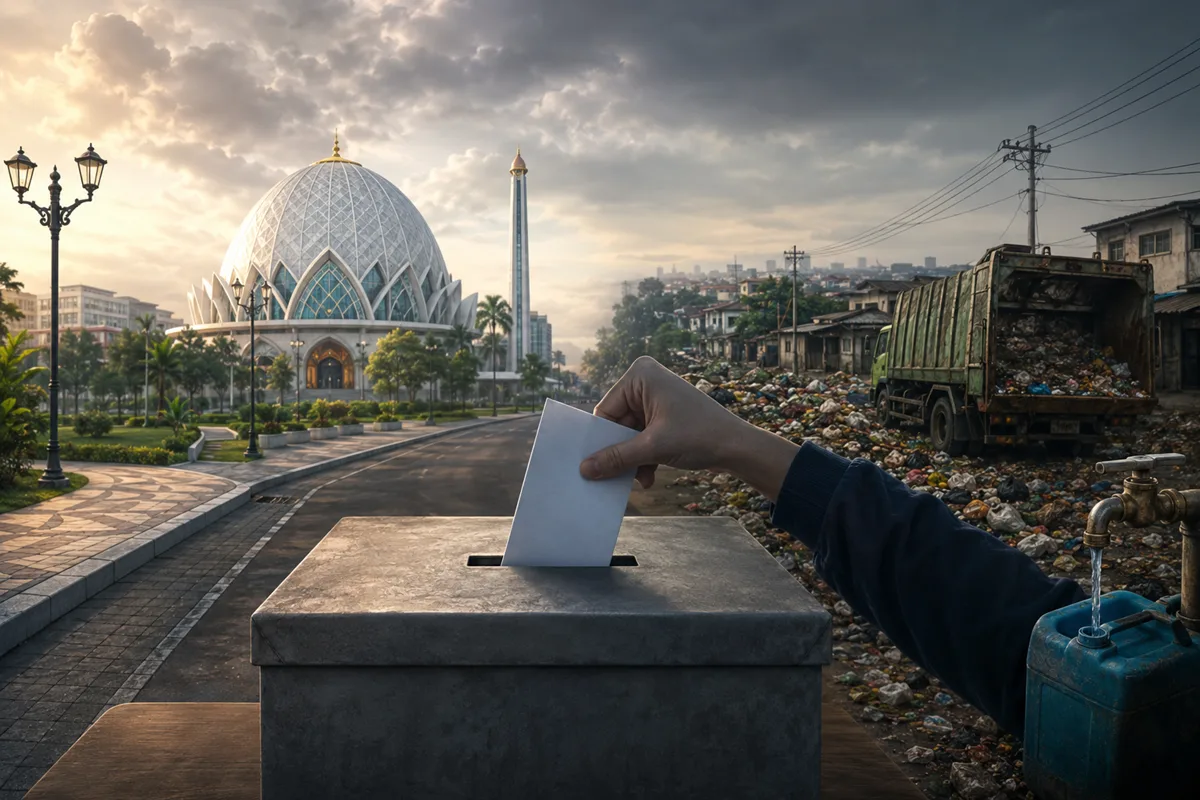
PANGKALPINANG, In a historic upset for local democracy, the 2024 mayoral election in Pangkalpinang City yielded a result that sent shockwaves through Indonesia’s political landscape. Despite running as a sole candidate backed by a massive, all-encompassing political party coalition (akin to the national "KIM Plus" alignment), the incumbent-backed ticket suffered a decisive defeat, losing directly to the "blank box" (kotak kosong) option.
The blank box secured 44.0% of the total vote, outperforming the sole candidate, who captured only 38.6%.
A study published in the Journal of Governance Innovation (Vol. 8, No. 1, March 2026) titled "Examining Incumbent Performance Accountability in a Single Candidate Local Election: A Case Study of the 2024 Pangkalpinang Local Election" delves deep into the root causes of this phenomenon. Authored by researchers Ariandi A. Zulkarnain, Imron Rosyadi Hamid, Sri Handayani, Dewi Ambarwati, Husnul Hakim, Dafis Ubaidillah Assiddiq, and Muhamad Imron, the comprehensive qualitative study reveals how formal developmental achievements can fail to guarantee electoral support when public representation and everyday governance fall short.
The Paradox: High Macro Achievements vs. Daily Life Reality
According to conventional retrospective voting theory, voters reward incumbents who deliver economic growth and visible development. On paper, the incumbent leadership of Pangkalpinang demonstrated remarkable performance metrics:
Booming Investment: Regional investment realization surged from IDR 279.5 billion in 2020 to roughly IDR 4.9 trillion in 2024—an increase exceeding 1,600%.
Iconic Landmarks: The administration successfully built the landmark Kubah Timah Grand Mosque (costing IDR 64 billion, designed by renowned architect Ridwan Kamil, and inaugurated in November 2023).
Urban Revitalization: Extensive projects improved city sidewalks, public parks, employment indicators, and municipal governance ratings.
The "Performance Gap"
However, the study highlights a severe performance gap—the discrepancy between official administrative outputs and the daily lived experiences of citizens. While the municipal government celebrated macro-level achievements, residents grappled with persistent, unaddressed public service deficiencies:
Waste Management Crisis: Pangkalpinang's 2.5-hectare landfill became heavily overloaded, struggling under 150 to 200 tons of daily garbage.
Transportation & Clean Water: Inadequate public transit routes, deteriorating vehicle fleets, and dry-season water shortages left suburban communities feeling neglected.
Local Economic Displacement: The rapid expansion of franchise retail outlets—exploding from 21 stores in May 2021 to 171 stores by March 2024—exerted intense competitive pressure on traditional market traders and local small businesses.
An LP3ES survey (January 2025) cited in the research showed that 57.6% of respondents felt their household economic conditions had not improved, while 27.4% reported that their economic situation had actually worsened. Macroeconomic growth had not trickled down to ordinary households.
The Key Factors Behind the Blank Box Victory
Why did voters actively choose an empty box over a heavily funded, fully backed sole candidate? The survey and field interviews pin the victory on three primary motivations:
| Primary Reason | Public Perception & Impact | Theoretical Framework |
| 1. Failure of Substantive Representation | Voters felt the sole candidate prioritized elite and investor interests over community needs. | Substantive Representation (Pitkin, 1967)
|
| 2. Protest Against Lack of Choice | Political party cartelization eliminated genuine competition, sparking a public backlash against elite candidate manipulation. | Protest Voting (Otjes et al., 2020)
|
| 3. Negative Candidate Track Record | Retrospective evaluations focused heavily on past administrative responsiveness and credibility rather than promotional claims. | Retrospective Voting (Fiorina, 1981)
|
Rather than abstaining from voting, citizens organized and strategically converted the blank box into an active institutional tool of democratic accountability.
Key Takeaways for Future Elections
The defeat of the sole candidate in Pangkalpinang offers vital lessons for local democracy across emerging economies:
Grand Coalitions Can Backfire: Oversized party coalitions that stifle competition can provoke public resistance, driving voters toward protest options.
Accountability is Multi-Dimensional: Favorable statistical reports and grand infrastructure projects cannot compensate for declining public trust, poor basic services, and perceived economic inequality.
Public Representation Matters: Democratic legitimacy relies on citizens feeling genuinely heard and represented by their political leaders.
With a re-election mandated by election laws, all eyes will be on how political parties and governance actors respond to this unambiguous demand for genuine political choices and responsive public service.
Source: Zulkarnain, A. A., Hamid, I. R., Handayani, S., Ambarwati, D., Hakim, H., Assiddiq, D. U., & Imron, M. (2026). Examining incumbent performance accountability in a single candidate local election: A case study of the 2024 Pangkalpinang local election. Journal of Governance Innovation, 8(1), 666–681. https://doi.org/10.36636/jogiv.v8i1.10390
Cover image source: Image generated by AI.