
Decoding the Screen: How British and American Game Shows Silently Shape Cultural Ideologies
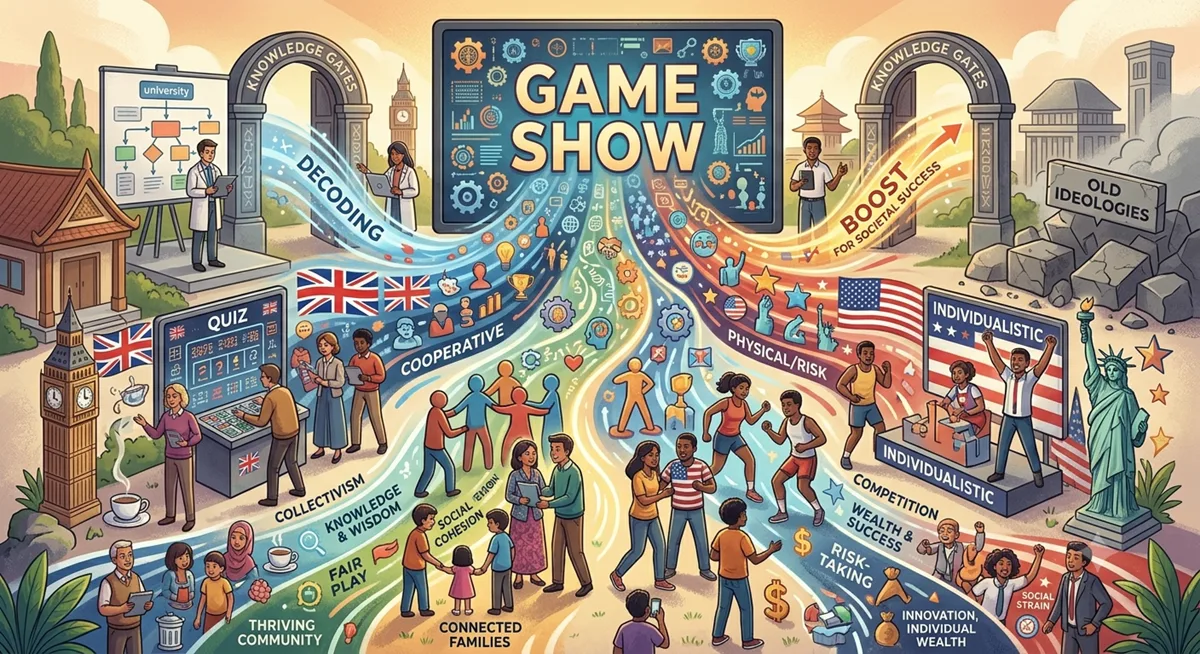
LONDON / NEW YORK — Have you ever wondered why watching a British game show feels like sitting through a quiet evening of intellectual pub trivia, while an American game show feels like an adrenaline-fueled Hollywood spectacle? While millions of viewers worldwide tune into these iconic television formats for lighthearted entertainment, groundbreaking media research reveals a far deeper dynamic at play. These programs are not merely innocent pastimes; they are sophisticated cultural texts that actively reflect, encode, and disseminate national ideologies to global audiences.
A study published in the academic journal Humanitatis: Journal of Language and Literature, authored by media researchers M. Gian Fathi Priyatama and M. Afifulloh from Universitas Bangka Belitung, offers a detailed semiotic investigation into this phenomenon. Drawing on the theoretical framework of renowned French semiotician Roland Barthes, the researchers analyzed iconic game shows from both sides of the Atlantic—including Who Wants to Be a Millionaire?, The Chase, Countdown, Jeopardy!, and The Wall—to uncover how visual, verbal, and auditory cues normalize distinct cultural value systems.
The Science of Signs: Denotation, Connotation, and Myth
To dissect these televised spectacles, the authors utilized Roland Barthes’s three-tiered model of semiotics:
Denotation (First-Order Signification): The literal, observable elements recorded on camera—such as studio lighting, set design, wardrobe, host dialogue, contestant movements, and background music.
Connotation (Second-Order Signification): The socio-cultural associations and emotional meanings attached to those literal signs.
Myth (Third-Order Signification): The overarching ideological narratives that naturalize cultural beliefs, making socially constructed ideas appear as self-evident, universal truths.
Through a comparative textual analysis of 37 British scenes and 44 American scenes, the study established striking structural contrasts in how each country constructs its version of public competition.
British Game Shows: Restraint, Collectivism, and the Gentleman Scholar
British television shows—exemplified by long-running staples like Countdown, Pointless, and the UK edition of The Chase—consistently emphasize civility, emotional composure, and intellectualism for its own sake.
Key Semiotic Features of UK Formats:
Aesthetic Moderation & Formal Attire: Minimalism dominated the visual sign category, with 84% of British scenes featuring subdued set designs with dark blue or gray neutral palettes. Formal attire (suits, ties) appeared in 89% of British scenes, reflecting a respect for traditional decorum and institutional authority.
Politeness & Low Emotional Display: Host-contestant interactions are characterized by supportive, unhurried exchanges. When faced with a tough question, hosts encourage reflection ("Take your time, no rush"). Upon winning, British contestants consistently display emotional restraint—offering polite smiles, modest handshakes, and a soft "Thank you very much".
Collectivism & Dignified Process: Programs frequently encourage team deliberation and shared decision-making (present in 59% of British scenes). Shows like Countdown reward intellectual agility with modest prizes (such as a commemorative teapot) rather than life-altering cash sums, celebrating knowledge over financial gain.
The Dominant British Myths:
At the mythic level, British game shows naturalize the ideals of "The Gentleman," "Fair Play," and "Dignified Competition." Success is framed as meaningful only when achieved through composure, humility, adherence to rules, and respect for social hierarchy.
American Game Shows: Individualism, Spectacle, and the American Dream
In stark contrast, American game shows operate in a high-octane semiotic universe driven by personal ambition, dramatic spectacle, and the moralization of material wealth.
Key Semiotic Features of US Formats:
Elaborate Sets & Auditory Drama: A staggering 93% of American scenes featured flashy, elaborate stage setups equipped with massive LED screens, vibrant color transitions, and technological displays. Auditory signs were dominated by dramatic orchestral cues, fast-paced beats, and tense ticking sound effects (91% of scenes), intentionally heightening emotional pressure.
Individual Achievement & Host Dominance: American formats foreground solitary performance, with individual contestant independence highlighted in 86% of scenes. Hosts function as charismatic showmen or star figures, dominating 95% of analyzed scenes with high-energy shouts and dramatic pauses ("Is that your final answer?!").
Euphoric Emotion & Material Validation: Victory in US formats is depicted as a dramatic crescendo. Contestants scream, leap, weep, and embrace hosts amid falling confetti. In shows like The Wall, cash prizes are framed as "life-changing money" that enables homeownership, debt relief, and family security.
The Dominant American Myths:
At the mythic level, US game shows perpetuate the narratives of "The American Dream," "Meritocratic Prosperity," and "The Self-Made Individual." Programs like The Wall carefully select veterans and community leaders, creating a moral economy where financial luck is presented as a natural reward for personal virtue and individual grit.
Statistical Breakdown: UK vs. USA Game Show Values
The researchers quantified the presence of core cultural indicators across both datasets, revealing a clear ideological divide:
| Cultural Value Indicator | British Game Shows (UK) | American Game Shows (USA) |
| Individualism | 33% | 90% |
| Collectivism | 67% | 10% |
| Aggressive Competition | 38% | 90% |
| Politeness & Decorum | 90% | 35% |
| High Emotional Expression | 25% | 80% |
| Spectacle / Entertainment Value | 30% | 87% |
(Source: Priyatama & Afifulloh, 2026)
Why It Matters in a Globalized Media Landscape
As television formats are continually syndicated, adapted, and streamed across global platforms, understanding these semiotic mechanisms is essential. The study demonstrates that game shows are not culturally neutral. Even when the underlying rules of a game remain identical, the subtle choices in set lighting, host dialogue, sound design, and contestant framing subtly instruct audiences on how individuals ought to behave in public, how success should be celebrated, and what values a society deems worthy of reward.
Source: Priyatama, M. G. F., & Afifulloh, M. (2026). A semiotic analysis of cultural values in British and American game shows using Roland Barthes' theory. Humanitatis: Journal of Language and Literature, 12(2), 177–190. https://doi.org/10.30812/humanitatis.v12i2.6271
Cover image source: Image generated by AI.