
Beyond Conservation: How Southeast Asian Ecotourism Research is Shifting Toward Social Justice and Inclusive Economies
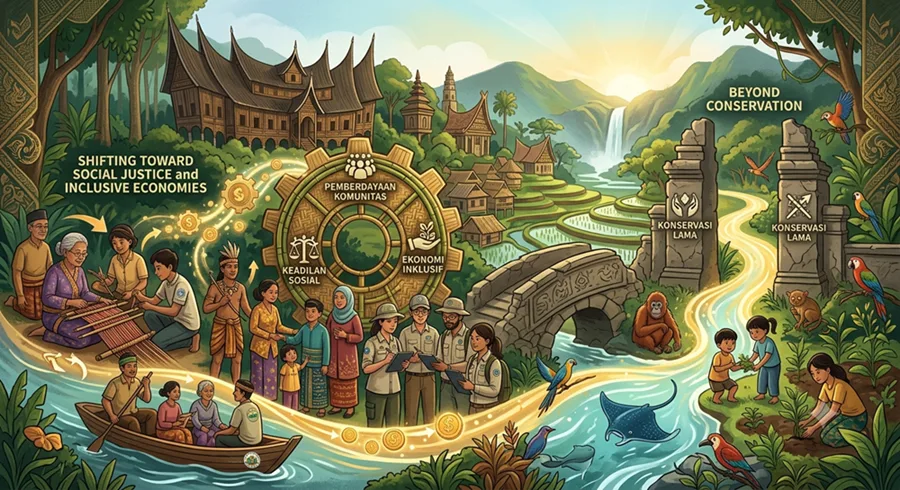
PANGKALPINANG — The global tourism landscape is undergoing a massive shift, moving away from conventional, exploitative models and embracing environmental and social sustainability. In Southeast Asia—a region boasting immense biodiversity across nations like Thailand, Malaysia, Indonesia, and the Philippines—ecotourism has fast become a crucial tool for environment-based resource management and local economic growth. However, academic understanding of this sector is evolving rapidly.
A newly published bibliometric study in the Journal of Innovation in Educational and Cultural Research (Volume 7, Issue 3, 2026) reveals that ecotourism research in Southeast Asia over the past decade has shattered its traditional boundaries. No longer confined strictly to ecological conservation, academic inquiry is shifting dynamically toward sustainable governance frameworks, community empowerment, and social justice.
The study, titled "Ecotourism Research Evolution in Southeast Asia: Key Trends and Future Directions," was conducted by an international collaborative team of researchers: Rendy (Universitas Bangka Belitung, Indonesia), Vieronica Varbi Sununianti (Universitas Sriwijaya, Indonesia), Iwano Junna (Kyushu University, Japan), and Adha Akasyah Bin Abd Razak (Universiti Putra Malaysia, Malaysia).
Mapping a Decade of Digital Knowledge (2014–2024)
Using sophisticated data processing tools like Bibliometrix and VOSviewer, the research team tracked and analyzed 377 peer-reviewed documents published between 2014 and 2024 across the prestigious Scopus and Web of Science databases. The temporal data revealed a steady upward trend in regional ecotourism publications, which peaked noticeably between 2018 and 2020 as academia responded to global mandates like the Paris Agreement.
The bibliometric mapping exposed several compelling structural insights regarding who is driving the ecotourism narrative in the region:
Thailand’s Academic Dominance: Thailand stands out as the absolute powerhouse and regional hub for ecotourism knowledge production. Srinakharinwirot University leads the pack by a staggering margin, contributing 174 articles, followed by other top Thai institutions like Kasetsart University and Mahidol University.
Global North-South Collaboration: While local institutions are major players, the international network is heavily tied to institutions in the Global North, notably led by the University of Göttingen (Germany) and the University of Tartu (Estonia).
The Indo-Malayan Gap: Despite possessing some of the richest natural biomes primed for ecotourism, countries like Indonesia and Malaysia show relatively lower publication volumes and underutilized international research networks. IPB University in Indonesia, however, remains a notable contributor with 16 articles.
Thematic Evolution: From Mangroves to Marginalized Voices
Historically, early academic literature focused tightly on niche ecological preservation, such as mangrove conservation in coastal zones. While terms like "Conservation" and "Biodiversity" remain highly relevant core pillars, keyword co-occurrence and quadrant thematic analyses show that the modern research stream has branched out dramatically into the socio-economic and institutional domains.
The authors argue that looking at ecotourism purely through an ecological or economic lens creates an elite-biased development process. True sustainable ecotourism must navigate complex socio-political contexts and resource claims.
As a result, contemporary research is forging heavily into "Basic Themes" like community-based ecotourism (CBT) and local empowerment. This shift addresses a critical question: how can local, often marginalized populations who depend directly on nature for their livelihoods enjoy an equitable distribution of benefits while mitigating climate risks?
"The findings show that ecotourism studies are not limited to conservation. Research directions have shifted toward biodiversity conservation, strengthening sustainable tourism frameworks, and inclusive economic approaches for local community well-being," the research team noted in their paper.
A Roadmap for Adaptive Governance and Technology
The practical implications of this study serve as a guide for policymakers, practitioners, and park managers across Southeast Asia. Because ecotourism narratives can inadvertently trigger issues of inequality or overtourism, the implementation of transparent, accountable, and participatory governance is vital.
Furthermore, the study identifies massive, unmapped frontiers for future exploration—specifically the role of digital technology. Utilizing real-time data tracking can help monitor tourist behavior and environmental degradation. However, researchers warn that stakeholders must proactively manage the "digital divide" to avoid further marginalizing local communities.
Ultimately, the paper calls for a deeply integrated, interdisciplinary approach that successfully blends indigenous local wisdom with data-driven, adaptive policies to protect both Southeast Asia’s ecosystems and its people.
Source: Rendy., Sununianti, V. V., Junna, I., & Razak, A. A. B. A. (2026). Ecotourism Research Evolution in Southeast Asia: Key Trends and Future Directions. Journal of Innovation in Educational and Cultural Research, 7(3), 515-525. https://doi.org/10.46843/jiecr.v7i3.2844