
Bridging the Gap: How Teachers Keep College Dreams Alive for High Schoolers in South Bangka
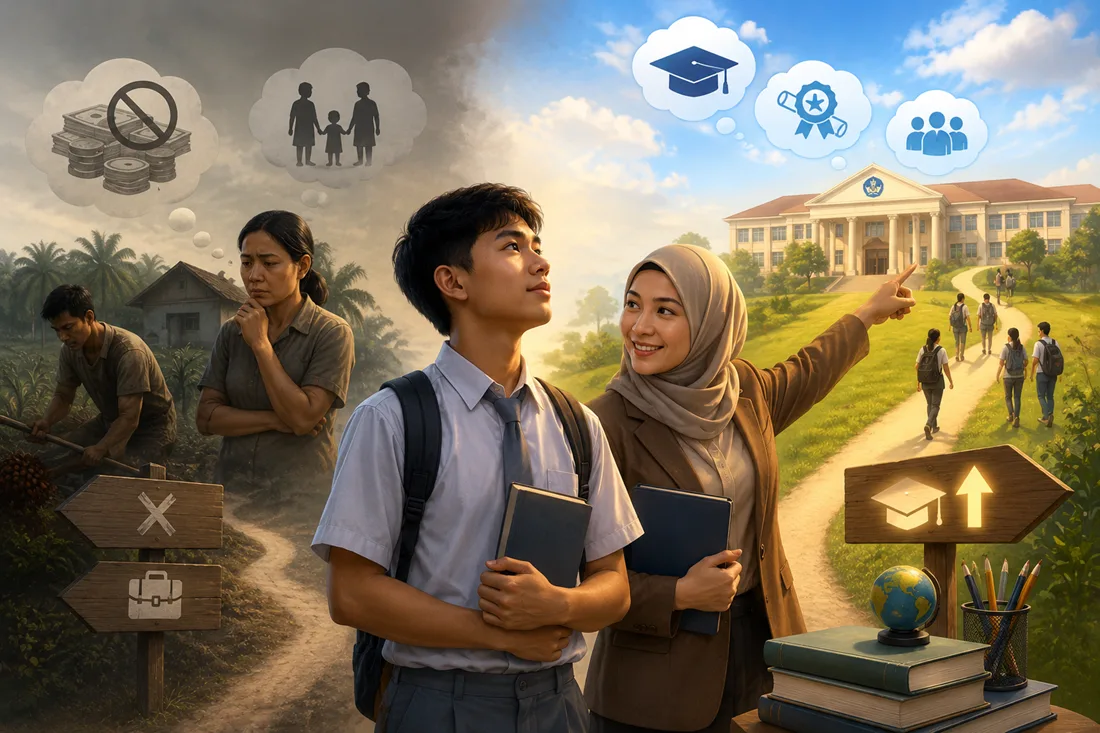
JAKARTA – For many senior high school graduates in major cities, transitioning to a public university (Perguruan Tinggi Negeri or PTN) is a natural next step. State universities are widely seen as the golden ticket—offering superior academic prestige, robust career networks, and lower tuition costs backed by government subsidies. However, in peripheral and non-metropolitan regions like South Bangka Regency, this transition remains a steep, uphill battle.
A recent qualitative study shed light on how socioeconomic hurdles destabilize the higher education aspirations of final-year high school students, and how educators are stepping up as crucial lifelines. The research, titled "From school to state university: The role of teachers in building high school students' motivation for further education," was published in COUNSENESIA: Indonesian Journal of Guidance and Counseling (June 2026).
Conducted by Hanifa Intan Desiga, Indah Puspita, and Poniman from Universitas Bangka Belitung, the study analyzed the testimonies of 14 participants—including high school principals, homeroom teachers, guidance counselors, and Grade XII students across South Bangka Regency. The findings expose a sobering reality: while the desire to pursue higher education exists, students’ motivation is incredibly fragile, constantly battered by economic limitations and deep-seated socio-cultural norms.
Fragile Ambitions in the Periphery
Using a descriptive qualitative approach and thematic analysis modeled after Miles and Huberman, the researchers discovered that the aspirations of Grade XII students in South Bangka are deeply unstable. Many students initially express an intrinsic drive to go to college to secure a better future. Yet, these dreams quickly falter when confronted with immediate financial constraints and family pressures.
"I actually want to go to college, but I'm still confused about the financial situation first," one student shared during the interviews. Another noted, "The cost issue, my parents didn't encourage me, I was told to go straight to work."
The data shows that in lower-income households, long-term educational investments are frequently overshadowed by immediate survival needs. Teachers reported that a significant number of students already work in local agricultural sectors, such as palm oil plantations, while still enrolled in school. Because they are accustomed to earning their own money, and because the local labor market offers jobs that do not require degrees, immediate employment is often viewed as the more practical and responsible path.
National statistics mirror this local crisis. According to data cited from the Central Bureau of Statistics (BPS), Indonesia's Gross Enrollment Rate (Angka Partisipasi Kasar or APK) for higher education sits low at around 32-33%. In the Bangka Belitung Islands Province, that number plummets even further, hovering at just 14.85% in 2022 and 18.19% in 2023. Shockingly, out of more than 13,000 high school graduates in the province in 2023, fewer than 34% went on to pursue a university degree.
The Weight of Family and Gender Roles
The study also highlights that a student's choice to attend college is rarely an independent one; it is heavily negotiated within the family structure. Beyond the sheer objective burden of tuition costs, psychological barriers play an immense role. Students openly admitted to fearing they would become a financial burden to their parents.
Furthermore, traditional socio-cultural mindsets still pose structural roadblocks. Principals revealed that some parents are hesitant to send their children to universities outside the region due to concerns over distance and safety. More concerningly, lingering gender biases persist. One school principal noted that some parents still believe higher education is unnecessary for young women, operating under the assumption that "if it's a girl, you'll eventually become a housewife again."
Even government-backed financial aid programs, such as the KIP Kuliah scholarship designed for economically disadvantaged students, have failed to completely bridge this gap. National data from 2025 indicated that only 22.1% of eligible Program Indonesia Pintar (PIP) recipients actually registered for KIP Kuliah. This proves that throwing financial assistance at the problem is insufficient if structural information barriers and familial resistance remain unaddressed.
Teachers as Strategic Intermediaries
When home environments offer little guidance, schools transform into vital institutional sanctuaries. The Universitas Bangka Belitung researchers found that teachers, principals, and guidance counselors play a monumental role in keeping college dreams alive by actively stepping in to fill information and emotional gaps.
Students consistently identified their teachers as their primary source of information regarding public university pathways, exams, and scholarship opportunities. Unlike students in major metropolitan areas who are regularly exposed to university campuses, students in peripheral zones require proactive intervention. One teacher explained, "In cities, students can directly see universities and understand the environment... here we are far away, so teachers must actively explain and describe it to them."
However, the study notes that school counseling systems are currently stretched thin and operate responsively rather than systematically. Guidance counselors reported that students rarely seek consultation voluntarily; instead, counselors must proactively call students into their offices one by one to offer career advice.
Where structured career planning fell short, experiential school programs proved highly effective. Students overwhelmingly cited school-organized university field trips as major turning points that boosted their determination. "Yesterday we had a field trip to campus... it made me want to go to university even more," an informant recounted.
A Call for Holistic Reform
The authors conclude that expanding equitable access to higher education in Indonesia’s underserved regions requires a massive departure from sporadic outreach programs.
To turn fragile student aspirations into actual university enrollments, the study calls for a comprehensive strategy. This includes building structured, sustainable school career guidance frameworks, elevating teacher capacity in career counseling, and optimizing digital access to information. Most importantly, policymakers and schools must actively involve parents as stakeholders through forums like "Parenting Days" to reshape domestic mindsets regarding the long-term value of a college degree.
Source: Desiga, H. I., Puspita, I., & Poniman, P. (2026). From school to state university: The role of teachers in building high school students' motivation for further education. COUNSENESIA: Indonesian Journal of Guidance and Counseling, 7(1), 123–139. https://doi.org/10.36728/cijgc.v7i1.6209