
Turning Pits into Paddies: How a Bangka Belitung Village Revitalized Tin-Mining Wastelands through Collective Action
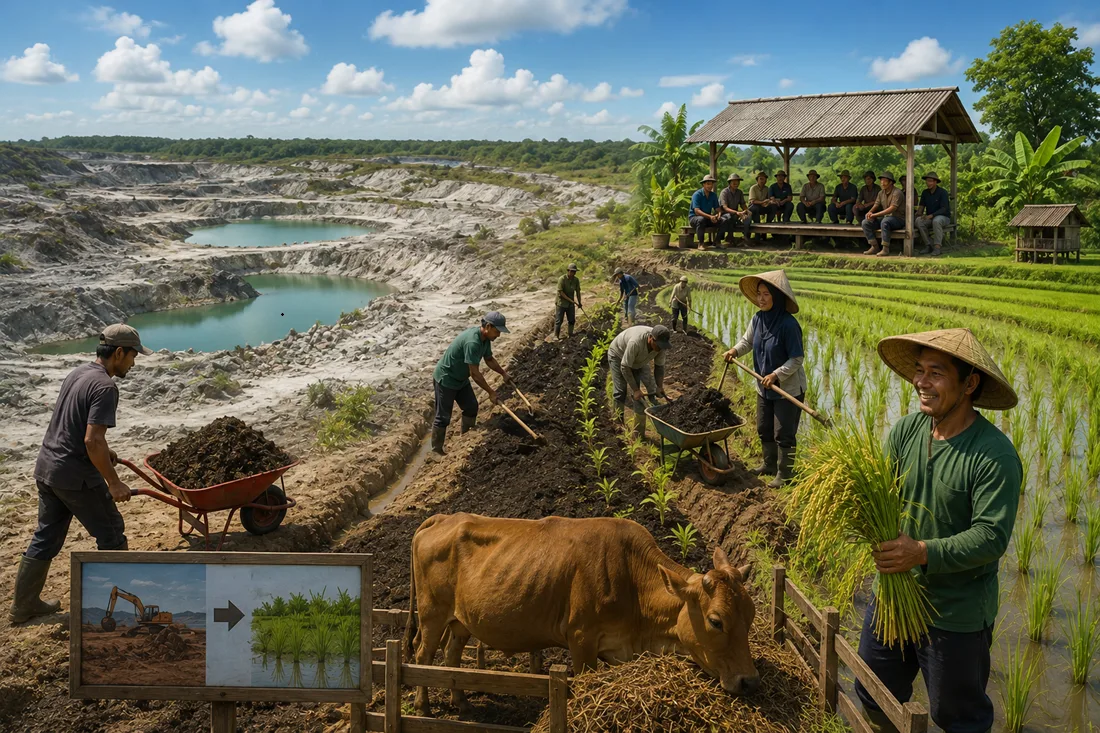
BANGKA – For over a century, large-scale tin extraction has heavily anchored the economy of the Bangka Belitung Islands, but it has also left behind a severely fractured landscape. Today, thousands of abandoned mining pits—locally known as kolong—and vast stretches of nutrient-poor, sandy tailings serve as stark reminders of ecological degradation.
However, a grassroots movement in Sinar Jaya Jelutung Village, Bangka Regency, is flipping the script on this environmental crisis. Organized under a local farmer group named Gapoktan Mekar Saja, residents have successfully transformed approximately eight hectares of barren post-mining land into highly productive wet-rice paddies.
This remarkable ecological transformation is highlighted in a qualitative study titled "Sustainable rehabilitation of post-mining land through community-driven ecological practices in Bangka Belitung, Indonesia," published in the IOP Conference Series: Earth and Environmental Science (2026). Authored by H. Herdiyanti, B. Suyanto, and S. Mas'udah from Airlangga University and the University of Bangka Belitung, the research demonstrates how grassroots agency can heal severely degraded tropical landscapes where industrial-scale reclamation often falters.
Healing the Soil with Cattle Manure
Before the intervention, the Sinar Jaya Jelutung site was an ecological wasteland. The soil consisted of coarse sand tailings with low natural fertility, virtually no organic matter, and highly unstable hydrology that alternated between severe droughts and sudden inundations.
Rejecting capital-intensive engineering technologies, the local farmers chose a labor-intensive, organic path. Utilizing communal labor, they manually cleared the land, leveled the sandy terrain, and constructed simple bunds and drainage networks to establish rudimentary hydrological control.
The turning point for the soil's biology came through an integrated rice-cattle approach. Supported by a government innovation program called "Abang Timah untuk Bu Disa" (Ex-Tin Mining Land for Wet-Rice Cultivation), the farmers were supplied with starter cattle. Over successive planting cycles, they systematically applied cattle manure and composted crop residues into the sand.
"Repeated additions of organic matter progressively enhanced soil aggregation and water retention," the researchers noted. Over time, the pale gray sandy tailings transformed into a darker, cohesive loam capable of holding standing water.
This organic intervention yielded extraordinary agricultural results. From a meager 1.3 tons per hectare during the initial trials in 2016, productivity skyrocketed. Local harvest records show that rice yields averaged 4.8 tons per hectare, peaking at 5.1 tons per hectare during the 2020 growing season. Field observations from 2024 confirm that despite recent reductions in state fertilizer assistance, yields have remained highly stable at around 4.7 tons per hectare.
Social Capital as the True Engine of Restoration
While the technical soil amendments were vital, the study underscores that social capital—manifested through deep-rooted community networks, trust, and mutual reciprocity—was the actual driving force behind the ecological recovery.
Rather than relying on expensive hired labor, approximately 25 to 30 households organized weekly labor-sharing rotations, known locally as kerja giliran or arisan tenaga. Each household contributed about one full day of work per week during the planting season to repair fragile bunds, manage irrigation channels, and distribute manure. This massive collective effort amounted to roughly 160 person-days of labor per hectare, significantly reducing transaction and operational costs.
The study utilizes sociologist Robert Putnam’s framework to break down the community's multi-layered social networks:
Bonding Capital: Dense kinship ties that fostered deep day-to-day cooperation and internal cohesion among the villagers.
Bridging Capital: Horizontal farmer networks that allowed the rapid diffusion of experimental soil-improvement techniques and composting knowledge.
Linking Capital: Vertical relationships with agricultural extension officers, which secured strategic external inputs like seeds, basic tools, and livestock.
This robust social infrastructure also gave birth to incredible adaptive resilience. For instance, when commercial fertilizer prices spiked sharply in 2023, the community did not abandon the fields. Instead, they collectively agreed to expand their localized composting pits and reuse fermented manure, cutting their input dependency by nearly 40%.
Navigating Regulatory Hurdles and the Road Ahead
The Sinar Jaya Jelutung case showcases a successful "co-production" model, where a grassroots initiative drives daily environmental management while the state acts as an enabler rather than a rigid coordinator.
This participatory approach stands in sharp contrast to Indonesia’s traditional top-down reclamation baseline regulated under Government Regulation (PP) No. 78 of 2010. While the state mandate strictly enforces engineering compliance—such as backfilling, slope stabilization, and replanting for physical safety—it lacks explicit mechanisms for restoring soil fertility for agricultural reuse or involving local communities in long-term land governance.
Despite the project's agronomic success, structural vulnerabilities still threaten its long-term survival. Because the rehabilitated fields are still legally classified under "temporary agricultural use on state land," the National Land Agency (BPN) cannot issue formal land certificates (sertifikat hak milik) to the farmers.
This insecure land tenure prevents farmers from securing agricultural insurance, accessing long-term credit, or qualifying for permanent state subsidies. Compounding this legal precarity is market instability, as local rice growers remain vulnerable to fluctuating spot prices controlled by informal traders.
To safeguard these hard-won ecological gains, the research team urges Indonesian policymakers to realign post-mining governance frameworks. They recommend that the Ministry of Energy and Mineral Resources (ESDM) revise PP No. 78/2010 to include livelihood-based indicators, and call for transitional land-use certification schemes to give communities legal recognition.
"Indonesia can transform reclaimed sites from degraded liabilities into productive, self-sustaining agroecosystems by embedding secure land rights and community participation into post-mining governance," the study concludes, offering Sinar Jaya Jelutung as a transferable model for sustainable post-extractive development across Southeast Asia.
Source: Herdiyanti, H., Suyanto, B., & Mas'udah, S. (2026). Sustainable rehabilitation of post-mining land through community-driven ecological practices in Bangka Belitung, Indonesia. IOP Conference Series: Earth and Environmental Science, 1580(1), 012040. https://doi.org/10.1088/1755-1315/1580/1/012040