
Bureaucratic Camouflage: MoRA Officials Shifting Stances Over Indonesia’s First State Confucian College in Bangka Belitung
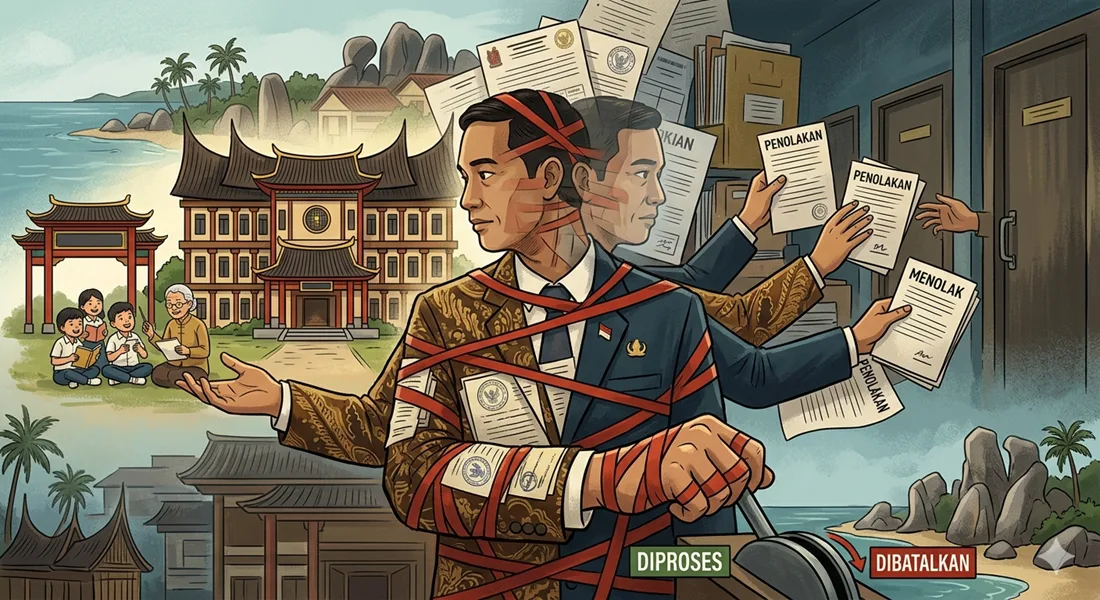
Jakarta – The central government's ambitious blueprint to inaugurate the country's first-ever Confucian State College—known as Sekolah Tinggi Agama Konghucu Indonesia Negeri (SETIAKIN)—in the Bangka Belitung Islands Province has exposed deep structural fault lines within state institutions. While the plan was heavily promoted to safeguard minority rights and project a modern image of religious moderation, it triggered intense backlash from conservative groups and exposed a silent, internal friction among regional civil servants.
A groundbreaking qualitative study titled "Institutional Divergence within the Ministry of Religious Affairs: Responses to the Establishment Plan of a State Confucian College," published in the linguistic and educational journal Loquēla (Volume 4, Number 1, 2026), uncovers how local officials structurally camouflaged their resistance to align with central directives.
The research was conducted by an academic team from Universitas Bangka Belitung (UBB), featuring Herza, M. Aries Taufiq, Izcha Pricispa, and Nur Faizza Tunnisa. Funded by a research grant from UBB's Institute for Research and Community Services (LPPM), the case study maps how bureaucrats navigate the fine line between personal ideological anxieties and career preservation.
Demographic Necessity Meets Discursive Resistance
The Ministry of Religious Affairs (MoRA) originally initiated the SETIAKIN development project in 2019 to rectify a severe shortage of qualified Confucian educators and religious counselors in public classrooms. Bangka Belitung was selected as the campus site due to its unique demographic profile; the province holds one of the largest concentrations of Confucian adherents in Indonesia, alongside West Kalimantan and West Java, with an ethnic Chinese community on Bangka Island exceeding 30,000 people.
SETIAKIN TARGETED PROGRAMS
├── 1. Religious Education for Confucian Teachers 🎓
├── 2. Religious Education for Confucian Religious Counselors 📜
└── 3. Public Communication Education 🗣️
Despite these practical drivers, public friction flared between 2022 and late 2023. Conservative mass organizations, such as the Bangka Belitung Islamic Ummah Alliance and the Central Bangka Islamic Ummah Alliance, staged formal protests and targeted audiences with the regional parliament (DPRD) and regional MoRA offices. The Indonesian Ulema Council (MUI) of Bangka Belitung similarly rejected the local site, suggesting the campus be moved to areas with higher ethnic Chinese majorities.
Using Michel Foucault’s framework of power/knowledge, the researchers explain that these hardline narratives successfully constructed a "discursive threat," claiming that the state college would invite aggressive religious proselytization and break the local Malay-Chinese social harmony. This occurred despite local data proving that Confucianism is traditionally non-proselytizing and develops primarily through close lineage networks.
The Anatomy of Institutional Divergence
The most striking finding of the UBB study is the internal division—conceptualized as institutional divergence—within the regional MoRA offices across the Provincial and Central Bangka branches. Local bureaucrats did not simply act as passive, top-down instruments of Jakarta's political will.
| Timeframe Period | Public & Institutional Stance | Behavioral & Bureaucratic Response | Underlying Rationality |
2022 – 2023
| High Polarization & Resistance
| Open objections in internal forums; questioning the urgency of a Confucian campus. | Influenced by local conservative pressures and personal religious identities. |
2024 – 2025
| Superficial Realignment & Neutrality
| Cessation of open criticism; outward expressions of institutional support. | Bureaucratic adaptation to maintain organizational stability and hierarchy. |
Source: Analytical Matrix of Attitudinal Shifting, Loquēla Journal (2026)
"Rather than operating in a linear, top-down manner, power circulates through multiple networks that enable local actors to reinterpret or quietly resist policy agendas," the authors write. Interview data revealed that a member of the Interreligious Harmony Forum (FKUB) affiliated with MoRA maintained strong links to banned hardline groups like Hizbut Tahrir Indonesia (HTI) and the Front Pembela Islam (FPI), actively bringing anti-SETIAKIN rhetoric into the semi-governmental apparatus.
Compliance Over Conviction: Pragmatic Bureaucracy
As the central government reasserted its mandates and accelerated project implementation toward July 2025, the research tracked an immediate, visible shift in local administrative behavior. The open resistance observed during 2022–2023 vanished, replaced by an artificial front of administrative alignment and neutrality.
The UBB researchers warn against misinterpreting this compliance as a genuine ideological shift or an embrace of pluralistic moderation. Instead, it represents a defensive posture and a calculated strategy for organizational survival. Within a rigid, hierarchical civil service, institutional loyalty to official decrees must take precedence over personal biases or localized social pressures.
Interestingly, senior administrative leaders at both the provincial and regency levels were fully aware of this internal ideological friction. Management chose to tolerate the dissenting personal views of their staff, treating the initial friction as a natural internal adaptation process, provided it did not escalate into active insubordination or bottleneck the construction schedule.
The case of SETIAKIN demonstrates that religious policy execution in modern Indonesia remains a complex, ongoing negotiation. Bureaucratic compliance does not guarantee an ideological consensus, and the state's push for structural inclusivity continues to run parallel to silent ideological resistance within its very own walls.
Source: Herza, Taufiq, M. A., Pricispa, I., & Tunnisa, N. F. (2026). Institutional divergence within the Ministry of Religious Affairs: Responses to the establishment plan of a State Confucian College. Loquēla (Journal of Linguistics, Literature, and Education), 4(1), 71–84. https://doi.org/10.61276/loqula.v4i1.99