
Dissecting Digital Democracy: How YouTube Comments Unveil the Firestorm Surrounding NasDem Politician Irma Suryani’s Election Fraud Claims
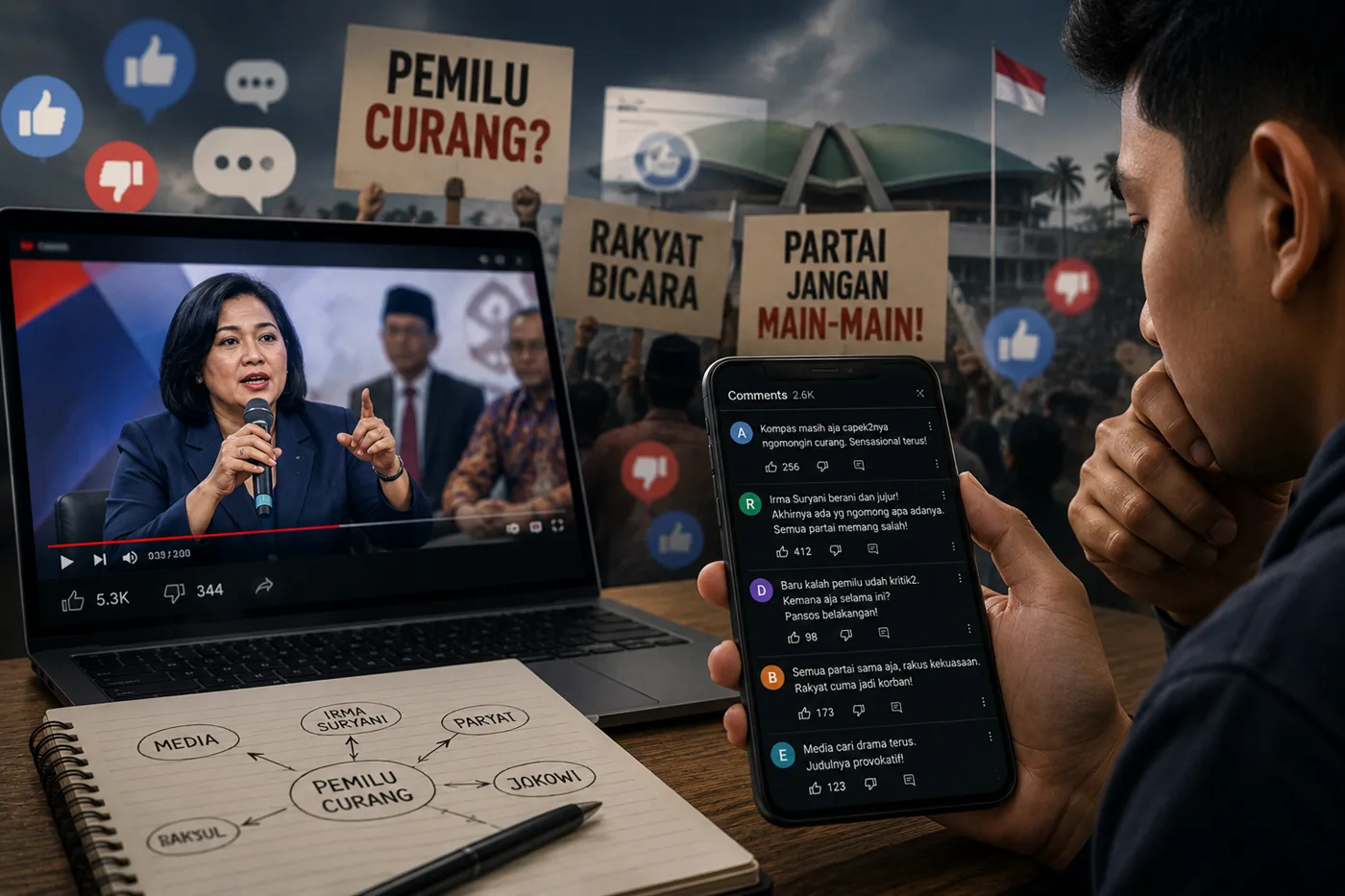
BANGKA, In an era where digital platforms serve as the new battleground for political ideology and public sentiment, social media comment sections have transformed into dynamic, unfiltered public spheres. A landmark academic study conducted by researchers at Universitas Bangka Belitung (UBB) delves into the complex web of public discourse following viral political commentary in Indonesia. Using advanced linguistic tracking, the study maps how everyday citizens engage with high-stakes political narratives, mainstream media framing, and electoral disputes.
The investigation centers on a viral video uploaded by KompasTV titled "Discussing Fraudulent Elections, Irma from NasDem Bluntly Criticises Political Parties, Jokowi, and Samsul". The broadcast showcased NasDem Party politician Irma Suryani delivering a scathing critique of political parties, election integrity, and the broader ruling elite during a high-profile forum on March 7, 2024, attended by Indonesia's 10th and 12th Vice Presidents.
Led by political scientist Robing alongside co-researchers Muhammad Rexsy, Friska Nabillah Putri, Reffo, and Yulianti, the team analyzed thousands of viewer reactions to decode the speech acts, ideological alignments, and polarization defining Indonesia's post-election digital landscape.
Inside the Irma Response Corpus: Methodological Precision
To capture organic public sentiment without artificial bias, the research team employed Corpus-Assisted Discourse Studies (CADS)—a hybrid framework merging computational corpus linguistics with critical discourse analysis. Using web-scraping techniques, the researchers extracted 2,611 raw YouTube comments, constructing the specialized Irma (NasDem Politician) Discussion Response Corpus.
Processed through the text-analysis tool AntConc (version 4.2.4), the corpus yielded a rich linguistic dataset consisting of 9,751 unique word types and 38,794 total tokens.
+-----------------------------------------------------------------------+
|                    THE IRMA RESPONSE CORPUS METRICS                   |
|   - Total Video Views      : 719,924                                  |
|   - Video Engagement       : 5.3K Likes (0.73%) | 344 Dislikes (0.04%) |
|   - Extracted Comments     : 2,611 (0.36%)                            |
|   - Total Tokens           : 38,794 words                             |
|   - Unique Word Types      : 9,751 words                              |
+-----------------------------------------------------------------------+
                                   |
                                   v
+-----------------------------------------------------------------------+
|                   KEYWORD FREQUENCY DISTRIBUTION                      |
|   - "Irma"                 : 792 occurrences (2.04%)                  |
|   - "Partai" (Party)       : 351 occurrences (0.92%)                  |
|   - "Rakyat" (People)      : 313 occurrences (0.81%)                  |
|   - "Politik" (Politics)   : 283 occurrences (0.73%)                  |
|   - "Nasdem"               : 182 occurrences (0.47%)                  |
|   - "Curang" (Fraudulent)  : 135 occurrences (0.34%)                  |
|   - "Pemilu" (Election)    : 91 occurrences  (0.24%)                  |
|   - "Samsul"               : 44 occurrences  (0.12%)                  |
+-----------------------------------------------------------------------+
By examining collocations, concordance lines, and speech acts, the study categorized viewer interactions across three primary targets: criticism directed at mainstream media outlets, attitudes toward Irma Suryani herself, and horizontal debates between peer commenters.
The Three Vectors of Public Sentiment
1. Backlash Against Media Framing
User comments directed toward the uploader, KompasTV, were predominantly negative, skeptical, or critical. Viewers expressed frustration with the media's framing—specifically targeting the channel's sensationalized title and the inclusion of the politically loaded term "Samsul" (a viral mockery aimed at vice-presidential candidate Gibran Rakabuming Raka).
Commenters accused mainstream media of stirring artificial drama and sensationalizing electoral disputes. Expressions such as "Kompas still isn't tired of repeatedly calling everything fraudulent" highlighted a growing public fatigue and distrust toward legacy media representations.
MEDIA SENTIMENT SPECTRUM
[Critical / Negative]  ████████████████████████████████  (Dominant)
[Neutral / Factual]    ██████████                        (Moderate)
[Supportive / Praise]  █                                 (Minimal)
2. Admiration vs. Suspicion: The Irma Suryani Dilemma
In stark contrast to media-directed vitriol, commentary focused on Irma Suryani was overwhelmingly positive and supportive. The keyword "Irma" appeared 792 times in the corpus, making her the primary focal point of discussion.
Supportive Illocutionary Acts: Viewers praised Irma for her candid, blunt, and direct communication style, viewing her as an authentic representative of the public rather than an elitist politician. Comments repeatedly described her as "honest," "objective," and "brave" for admitting that political parties—including her own—bear responsibility for systemic flaws.
Skeptical & Rejecting Acts: A vocal minority dismissed her statements as insincere post-election political theater. Skeptics labeled her a "sycophant of power," questioning why she waited until after the elections to speak out against oligarchy and political corruption.
3. Peer-to-Peer Polarization in the Comments Section
Direct interactions between users revealed deep ideological fractures. When debating Irma's assertion that "all political parties are at fault," user discussions devolved into intense symbolic conflicts.
| User Target Category | Primary Sentiment | Key Speech Act Characteristics | Underlying Driver |
Media Outlets (KompasTV)
| Negative / Critical | Accusations of clickbait, sensationalism, and biased news framing. | Distrust in legacy media neutrality. |
Political Figure (Irma)
| Predominantly Positive | Praise for honesty, directness, and self-awareness. | Emotional resonance with non-elitist rhetoric. |
Peer Commenters
| Polarized / Divided | Counter-arguments, political labeling, and ideological defense. | Partisan bias and affective loyalty. |
(Source: Compiled from CADS analysis in the Irma Discussion Response Corpus, 2025)
Dismantling the Illusion of Blame: "We Are All to Blame"
A pivotal segment of the discourse focused on Irma Suryani’s explicit statement regarding election fraud and party accountability:
"So, don't let PDI-P say that Jokowi is the one to blame. No—we are all to blame. As someone from a political party, as one of the leaders in NasDem, I say the political parties are the most at fault."
This statement triggered three distinct categories of illocutionary speech acts among the digital public:
Supportive Responses: Users applauded her self-awareness, noting that political parties consistently fail to pass anti-corruption legislation or asset forfeiture bills.
Rejecting Responses: Critics argued that individual politicians cannot wash their hands of responsibility by simply blaming abstract "parties," urging her to "judge yourself first."
Doubtful Responses: Skeptical commenters pointed out the contradiction of a sitting party leader criticizing the very system she operates within, questioning her true motives.
Digital Media as an Affective Arena
The findings of the UBB research team affirm that video-sharing platforms like YouTube are no longer passive entertainment channels. Instead, they function as high-stakes discursive arenas where affective publics congregate, articulate collective emotions, and challenge political narratives.
By utilizing Corpus-Assisted Discourse Studies, the researchers demonstrated how computational linguistic tools can untangle complex public sentiments in real-time. In an increasingly fragmented media ecosystem driven by emotional bias and political polarization, understanding user-generated commentary provides critical insights into the health and future of digital democracy in Indonesia.
Source: Robing, Rexsy, M., Putri, F. N., Reffo, & Yulianti. (2025). Analysis of YouTube user responses to the discussion of NasDem politician Irma Suryani: A corpus-based discourse analysis. Journal of Social Politics and Governance (JSPG), 7(1), 1–14. https://doi.org/10.24076/n795f177
Cover image source: The cover image is an AI-generated image.