
From Tin Mining to Tourism: Bangka Belitung Turns to Social Media for Sustainable Growth
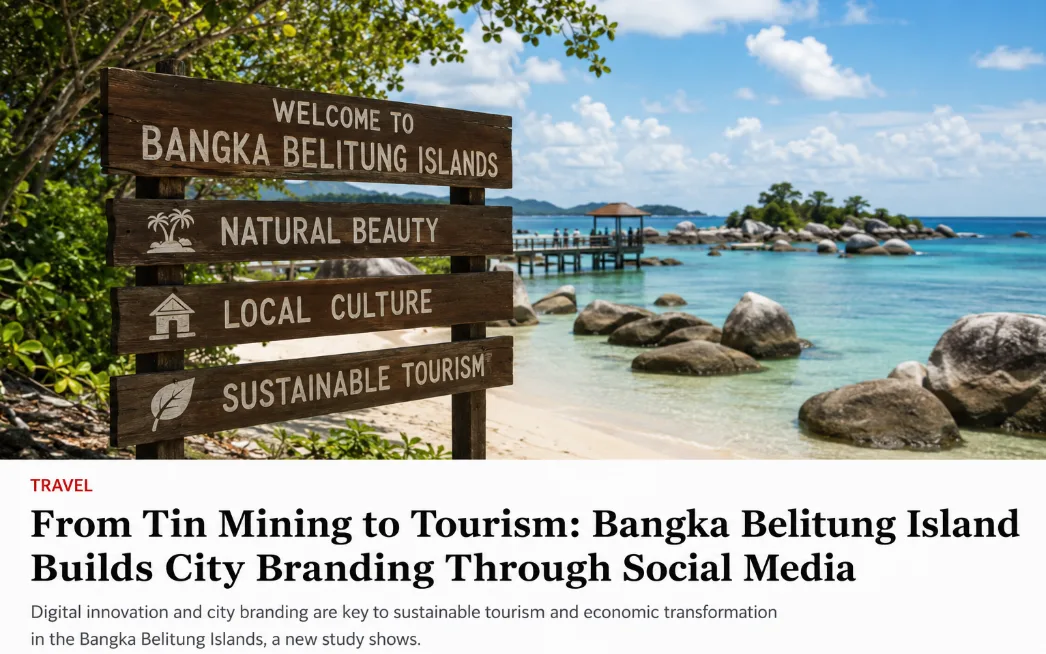
Bangka Belitung — The Bangka Belitung Islands are increasingly relying on social media and digital branding to transform their economy from tin mining dependency into sustainable tourism development, according to a recent study by researchers from Universitas Bangka Belitung.
The study, titled City Branding and Sustainability: The Role of Social Media Innovation in Promoting Tourism as Sustainable Development, was published in the IOP Conference Series: Earth and Environmental Science following the 7th International Conference on Green Energy and Environment (ICoGEE) 2025.
Researchers said Bangka Belitung has long depended on tin mining as its primary economic sector. In 2021, the province reportedly controlled around 90 percent of Indonesia’s tin market, supported by billions of tons of tin ore reserves. However, mining activities have also caused environmental degradation, social conflicts, and threats to local culture.
The study argues that tourism offers a more sustainable economic alternative for the island province. Researchers highlighted the region’s coastal ecosystems, white-sand beaches, marine tourism potential, and the coexistence of Malay and Chinese cultural heritage as key assets for future development.
“To shift from an extractive economy to a sustainable economy, tourism development supported by social media innovation becomes strategic,” the researchers wrote.
According to the study, the Bangka Belitung provincial government has intensified efforts to build “city branding” through digital platforms. The province currently has 402 tourist destinations consisting of natural, cultural, historical, and man-made attractions.
Social media has become a central instrument in promoting those destinations. The official Instagram account @visitbangkabelitung_ alone has uploaded more than 1,700 posts featuring beaches, culinary tourism, and cultural attractions as part of a digital tourism campaign.
Researchers found that digital engagement plays an important role in shaping tourist perceptions. High-resolution photos, videos, hashtags, and location tags were shown to increase interaction and improve destination visibility online.
The study also documented the rapid growth of tourism-related social media activity in the province. Researchers recorded at least 24 tourism-focused accounts actively promoting destinations across Bangka Belitung, while tourism-related hashtags generated more than 52,000 posts on social media platforms.
Tourism stakeholders involved in the digital promotion ecosystem include local governments, travel agencies, tourism awareness groups, hotels, culinary businesses, and ordinary tourists sharing travel experiences online.
Despite the growing online visibility, researchers noted that social media promotion has not yet been fully optimized to attract more tourists from outside the region. Many posts still lack complete information such as destination descriptions, hashtags, or geolocation details.
The study concluded that integrating social media innovation, city branding, and smart-city principles could strengthen Bangka Belitung’s transition toward a more inclusive and environmentally sustainable economy.
Source: Sulaiman, A., Astuti, R. P., & Hayati, L. (2026). City branding and sustainability: the role of social media innovation in promoting tourism as a sustainable development. IOP Conference Series: Earth and Environmental Science, 1580(1), 12012. https://doi.org/10.1088/1755-1315/1580/1/012012