
Preserving Social Harmony: How Javanese Identity Endures in Multilingual Interactions
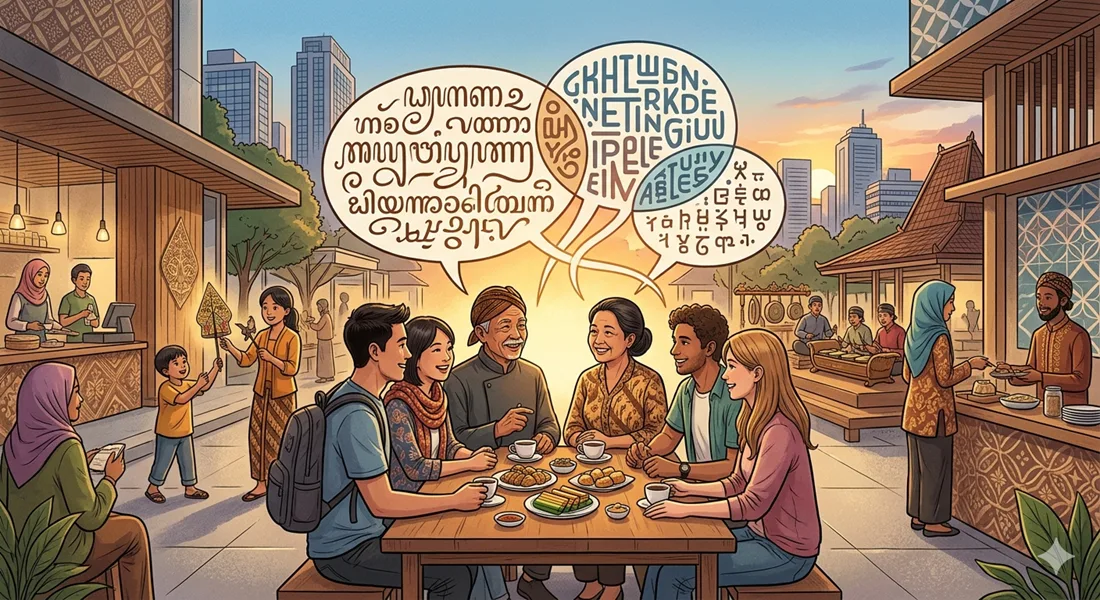
Yogyakarta – Javanese culture has long been recognized for its unique linguistic structure, where maintaining social harmony is deeply intertwined with speech levels. While modern shifts show the younger generation increasingly favoring the egalitarian nature of Bahasa Indonesia, a recent study reveals that core Javanese cultural values—specifically the focus on prioritizing the "face" and feelings of others—remain deeply rooted, even when communicating in multilingual settings.
The study, titled "Face and Politeness in Javanese Multilingual Interaction," was conducted by researchers Emi Nursanti, Sailal Arimi, and Nurvita Wijayanti from Universitas Negeri Yogyakarta, Universitas Gadjah Mada, and Universitas Bangka Belitung. Published in Issues in Language Studies (Volume 13, Number 1, 2024), the mixed-methods research examined linguistic data from a cultural webinar hosted by the Yogyakarta Palace (Kraton Jogja) to analyze how modern Javanese speakers navigate face-saving acts.
The Data: Prioritizing 'The Other' Over 'The Self'
By applying a specialized sociolinguistic framework that categorizes "face" into four distinct needs—self-positive face (SPF), other-positive face (OPF), self-negative face (SNF), and other-negative face (ONF)—the researchers tracked the precise distribution of politeness strategies utilized by Javanese speakers:
| No. | Face-Need Concern | Key Characteristics | Frequency Percentage |
| 1. | Other-Positive Face (OPF) | Desires to compliment, greet, and validate others. | 44.34% |
| 2. | Other-Negative Face (ONF) | Desires to respect boundaries and avoid imposing on others. | 39.15% |
| 3. | Self-Negative Face (SNF) | Desires to protect one's own freedom and boundaries. | 11.32% |
| 4. | Self-Positive Face (SPF) | Desires to pursue personal approval or display competence. | 5.19% |
Source: Face-need Concern in a Javanese Multilingual Interaction (Nursanti et al., 2024)
The quantitative results highlight a striking phenomenon: over 83% of all politeness strategies deployed by the participants were focused entirely on protecting the face of the interlocutor (other-oriented) rather than the speakers themselves (self-oriented).
The Mechanism: Compliments and Krama Deference
According to the study, the overwhelming dominance of Other-Positive Face (44.34%) stems directly from the Javanese cultural concept of ngemong rasa—the practice of deliberately controlling one's own desires to preserve the feelings of others. In practice, webinar hosts and participants frequently utilized positive politeness behaviors such as offering sincere compliments, warm greetings, and expressing layered levels of gratitude.
Concurrently, Other-Negative Face (39.15%) was heavily maintained through deliberate indirectness and linguistic cushioning. To avoid sounding demanding or confrontational, speakers heavily relied on modifying phrases like "mungkin" (perhaps/maybe) to soften verbal requests.
The most prominent marker of enduring Javanese identity within the multilingual forum—which blended Bahasa Indonesia, English, and Japanese—was the strategic insertion of Javanese Krama (high-level honorific speech). Even when a sentence was delivered primarily in Bahasa Indonesia, speakers naturally code-switched to terms like ngendika (said), nyaosi pirsa (explain), or nyawisaken (prepare) when referring to individuals of higher status or the King of the Yogyakarta Palace (Ngarsa Dalem).
"Their strong Javanese identity makes the palace members tend to insert words in Javanese Krama to mark their polite utterances. They kept using Javanese Krama for words showing deference since it is the only variety that can perfectly express deference upheld by Javanese people."
The Psychology of 'Isin' and 'Andhap-Asor'
Conversely, the study found that Javanese interactants showed extreme reluctance to elevate their Self-Positive Face (5.19%). When asked about their successes or skills, participants routinely deflected praise toward their instructors rather than claiming individual competence.
The researchers attribute this low self-assertion to the deep-seated cultural ethics of andhap-asor (humbling oneself while exalting others) and sepi ing pamrih (selflessness). Furthermore, Javanese social behavior remains intensely regulated by isin (shame) and ewuh pekewuh (a structural feeling of awkwardness or guilt over potentially inconveniencing someone else). To avoid the negative social labels of being ora duwe rai (having no face/shame), individuals instinctively craft their dialogue to protect collective social harmony.
Ultimately, the research proves that while modern Indonesian society continuously adopts global and national languages for utility and egalitarian alignment, underlying ethnic identities continue to dictate the subconscious rules of politeness and social respect.
Source: Nursanti, E., Arimi, S., & Wijayanti, N. (2024). Face and politeness in Javanese multilingual interaction. Issues in Language Studies, 13(1), 181-197. https://doi.org/10.33736/ils.5690.2024