
Shifting Paradigms: Why Score-Driven Training Fails Senior English Teachers
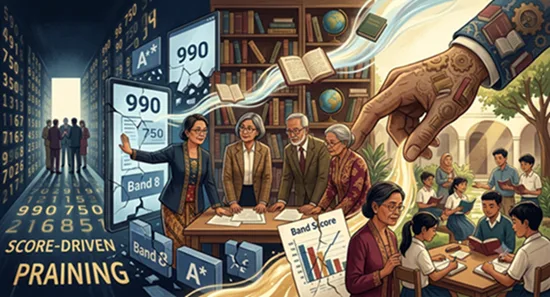
PANGKALPINANG — For decades, professional development programs for in-service English teachers have operated under a rigid, quantitative metric: the pursuit of high test scores and rigid certification compliance. However, a groundbreaking qualitative study reveals that this outcome-driven approach often triggers deep-seated anxiety and a sense of deficiency among senior educators.
The study, published in Inspiring: English Education Journal (March 2026), argues that humanizing the educational ecosystem through structured "reflective practice" is the missing link to transforming stressful test-centric workshops into spaces for sustainable professional growth.
The research, titled "From Scores to Self-Confidence: Reflective Learning in English Professional Development for In-Service Teachers," was conducted by Hilda Rakerda and Dini Wulansari from Universitas Bangka Belitung.
The Hidden Burden of the Senior Educator
The researchers conducted an intensive 12-day training program in collaboration with the Provincial Education Office of Bangka Belitung. The project specifically focused on 20 experienced in-service teachers aged 40–55 who possessed more than 15 years of secondary education teaching experience.
Despite their extensive backgrounds, many senior teachers confessed to entering the training with acute feelings of vulnerability and self-doubt. The data collected from interviews and reflective writings highlighted a stark reality:
Administrative Suffocation: Senior teachers are frequently so overwhelmed by policy compliance and bureaucratic demands that they have zero time left for personal linguistic upkeep.
The Deficit Trap: Standardized proficiency tests, such as TOEFL-driven assessments, often inadvertently treat these veteran educators as deficient test-takers rather than seasoned professionals, severely bruising their confidence.
The Age Narrative: Many participants entered the program believing that learning a language becomes increasingly stagnant or impossible in the later stages of a career.
From Scores to Self-Discovery
The research team altered the status quo by introducing structured reflective writing, post-test dialogues, and peer interactions via WhatsApp groups. Rather than treating proficiency tests as a final judgment, the researchers used test results merely as stimuli to help teachers safely confront and evaluate their learning processes.
The results were transformative. Instead of obsessing over numerical scores, teachers began to view test results as a baseline to identify their professional weaknesses and celebrate minor progressive victories.
"My score may not be outstanding, but I realized that I am still capable of learning and improving," one participant remarked during the interviews.
By processing their learning anxiety collaboratively, senior teachers successfully challenged internalized age barriers and reclaimed their identities as active, lifelong language learners.
The Power of WhatsApp and Peer Solidarity
A vital revelation from the study was that reflection is not merely an isolated, individual task; it thrives as a collective social practice. Continuous digital interactions on WhatsApp became informal reflective havens where senior teachers shared real-time moral support, normalized mistakes, and regulated teaching anxiety.
Rakerda and Wulansari conclude that globally tied accountability structures must stop reducing teacher performance to quantifiable data points. If ministries and education offices genuinely wish to build resilient, adaptive educators, professional programs must intentionally build spaces that protect the professional dignity and emotional well-being of the people running the classrooms.
Source: Rakerda, H., & Wulansari, D. (2026). From scores to self-confidence: Reflective learning in English professional development for in-service teachers. Inspiring: English Education Journal, 9(1), 19-39. https://doi.org/10.35905/inspiring.v9i1.16472