
Study Finds Bangka Folklore Holds Untapped Potential for Literary Tourism
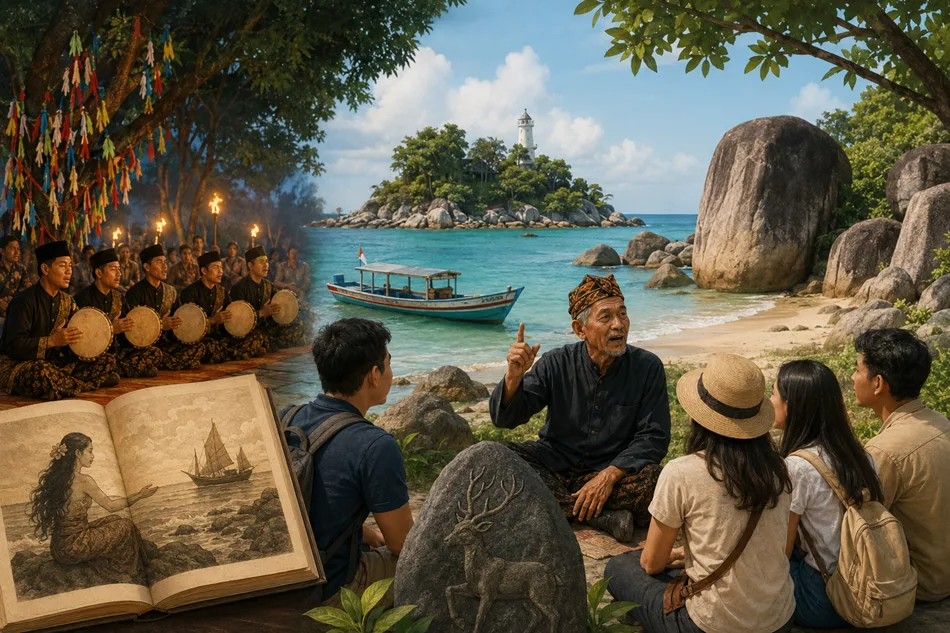
Pangkalpinang – A recent study conducted by researchers from Universitas Bangka Belitung found that folklore across several tourist destinations on Bangka Island has significant potential to support literary and culture-based tourism, although much of that potential remains underutilized.
The study, published in the 2025 edition of Lire Journal (Journal of Linguistics and Literature), examined how local legends and oral traditions contribute to tourism identity at destinations such as Batu Rusa, Dempu Awang, and Penyusuk Beach in Bangka Belitung Province.
Researchers Resti Amalia, Donal Fernado Lubis, and Tri Arie Bowo found that folklore serves not only as a cultural narrative but also as an important element shaping visitors’ experiences and strengthening local identity.
According to the study, Batu Rusa was identified as one of the destinations with the strongest integration between folklore and tourism activities. The site combines legends, rituals such as Ratib Saman, torch parades, culinary traditions, and historical landmarks into a multidimensional tourism environment.
Researchers described the integration as a form of “full narrative activation,” in which stories, rituals, and place identity reinforce one another to create a richer tourism experience for visitors.
In contrast, the study found that the legendary narrative of Dempu Awang, despite being symbolically rich and strongly associated with Batu Balai Beach, has not been fully transformed into tourism activities. Researchers noted the absence of regular cultural performances, interpretive programs, or storytelling events that could bring the legend to life for tourists.
A similar condition was observed at Penyusuk Beach. Although the beach possesses strong natural attractions and folklore linked to the naming of surrounding islands, researchers found that cultural storytelling remains minimally integrated into tourism development.
The paper explained that many tourism policies in Bangka still focus more heavily on tangible heritage such as historic buildings, culinary festivals, and religious architecture, rather than intangible cultural heritage like folklore and oral traditions.
Researchers also identified several missing elements that limit the development of folklore-based tourism, including the absence of interpretive signage, storytelling guides, narrative tour routes, digital folklore archives, and integration of local stories into tourism festivals.
Using literary tourism theory, the study argued that Bangka Island already possesses the essential components needed to develop narrative-driven tourism. These include culturally rich folklore, landscapes connected to specific stories, and local communities that continue to preserve oral traditions.
The researchers compared Bangka’s unrealized potential with the success of Belitung through the popularity of the literary work Laskar Pelangi, which transformed the neighboring island into one of Indonesia’s well-known tourism destinations.
According to the paper, folklore can enhance tourism by providing visitors with deeper emotional experiences, strengthening authenticity, and encouraging greater community involvement in cultural preservation.
The study concluded that integrating folklore into tourism development through storytelling activities, cultural performances, guided tours, and interpretive materials could strengthen Bangka Island’s tourism identity while preserving local intangible cultural heritage for future generations.
Source: Amalia, R., Lubis, D. F., & Bowo, T. A. (2025). LITERARY TOURISM STUDIES IN FOLKLORE AT TOURIST ATTRACTIONS IN BANGKA ISLAND. Lire Journal (Journal of Linguistics and Literature), 9(3), 641-653. https://doi.org/10.33019/lire.v9i3.540