
Study Finds Puppet Drama Improves English Speaking Skills Among Young Learners
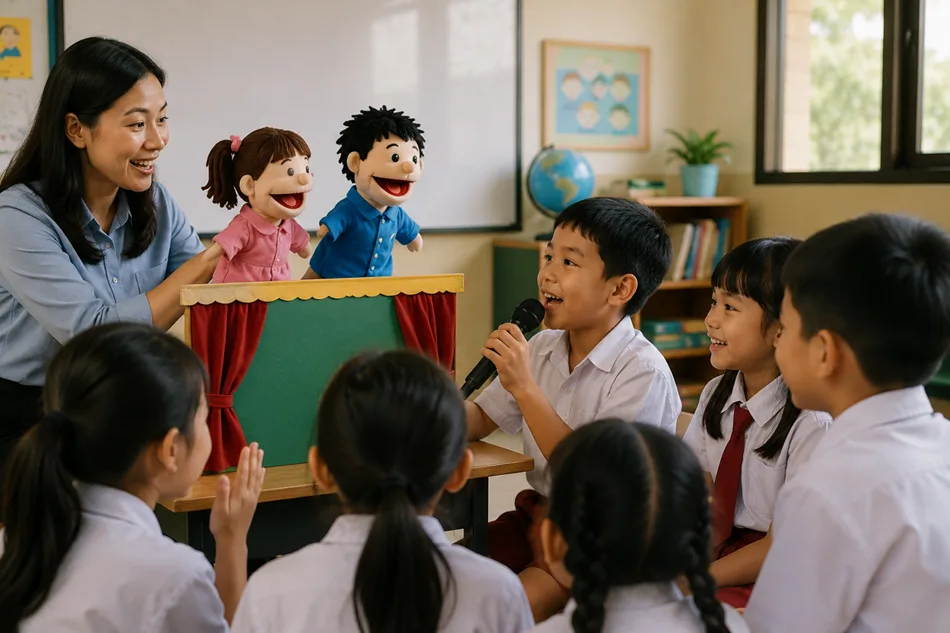
Jakarta – A recent study by researchers from Universitas Bangka Belitung found that the integration of puppet drama in English classrooms significantly improved speaking skills, confidence, and classroom engagement among elementary school students.
The study, titled The Use of Puppet Drama to Engage Speaking Skill of Young Learners, was conducted by Retno Wulan, Agnes Iga Pratiwi, and Marsandi Manar and published in the 2025 edition of JELT: Journal of English Language Teaching.
The research involved 22 fifth- and sixth-grade students participating in an English extracurricular program at a private primary school in Jambi Province. Researchers employed classroom action research over four months to observe how puppets and drama activities influenced students’ participation and speaking performance.
According to the paper, many students initially showed low confidence in speaking English. The classroom atmosphere was described as noisy and difficult to manage, with several students appearing passive, shy, and reluctant to communicate in English during lessons.
Researchers found that traditional classroom activities failed to provide enough opportunities for students to practice speaking. Many students relied heavily on their mother tongue and quickly became bored with repetitive learning materials.
To address the problem, the researchers introduced puppet drama activities using simple story scripts such as Little Red Riding Hood, Best Friends Forgive, The Spirit Inside the Bottle, and The Good Man and His Son. Students practiced dialogues, role-play, pronunciation, and storytelling while using hand puppets representing different family characters.
The study found that puppet drama created a more relaxed and enjoyable classroom environment, helping students reduce anxiety and become more willing to speak English in front of their peers. Researchers noted that students gradually became more enthusiastic, focused, and emotionally engaged during classroom activities.
Data from the study showed a steady increase in classroom engagement. Students’ engagement scores improved from 71.1 percent during the pre-implementation stage to 86 percent in the first cycle and 92 percent in the second cycle after puppet drama activities were intensified.
Researchers also observed improvements in pronunciation, vocabulary mastery, and self-confidence. Students became more active in answering questions, giving comments, and interacting with classmates during speaking exercises.
The paper explained that puppets allowed students to experiment with language more freely because mistakes were perceived as part of the puppet’s performance rather than personal failures. This reduced students’ fear of making errors while speaking English.
In addition, the integration of drama encouraged collaborative learning and peer interaction. Students worked in groups, practiced role-playing, and improvised conversations, which researchers said strengthened motivation and classroom participation.
The study concluded that puppet drama can serve as an effective and enjoyable teaching method for young English learners, particularly in improving speaking ability and classroom engagement. Researchers suggested that future studies explore the use of puppets and drama in different educational contexts and teaching models.
Source: Wulan, R., Pratiwi, A. I., & Manar, M. (2025). The use of puppet drama to engage speaking skills of young learners. JELT: Journal of English Language Teaching, 9(2), 116–127. http://dx.doi.org/10.33087/jelt.v9i2.201