
Mind the Gap: UBB Research Reveals Hidden Psychological Barriers Behind Higher Education Unemployment in Bangka Belitung
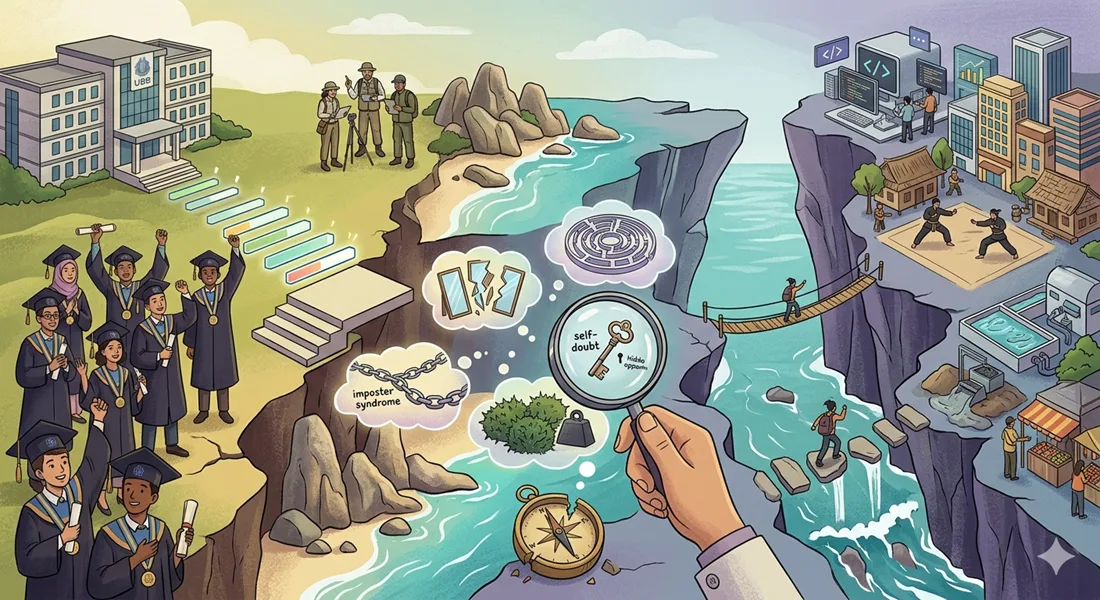
Bangka – The struggle of university graduates to secure employment remains a glaring socio-economic issue across Indonesia. While structural changes and rapid digital adaptation are often blamed, a brand-new study from the archipelagic region of Bangka Belitung Province indicates that the issue goes far deeper than a simple mismatch of textbook data. Higher education is not just experiencing a curriculum crisis; it is facing a critical psychosocial disconnect.
The breakthrough study, titled "Skill Gap Analysis of Human Resources Between Higher Education and the Workforce in Bangka Belitung Province," was published in the reputable journal Psychological Research and Intervention (Volume 8, Issue 1, 2025).
The research was spearheaded by an academic team from Universitas Bangka Belitung (UBB), consisting of Poniman, Rifki Aditia Novaldi, Hanifa Intan Desiga, and Natasha. Supported by a research assignment grant from UBB (Letter No. 781/UN50/M/PP/2025), the authors took a qualitative case-study approach to explore why university alumni continue to struggle in regional labor markets.
Beyond Curriculum: The Psychological Toll of Theoretical Curation
According to national statistics highlighted in the paper, university graduates accounted for roughly 13.89% of national unemployment as of February 2025, with an open unemployment rate floating around $\pm5\%$. Furthermore, industry surveys indicate that over 50% of hiring managers find modern graduates lacking the core technical and soft skills required for the modern corporate arena.
Through intensive interviews and focus group discussions with industries, local governments, and academic administrators, the UBB research team uncovered three interconnected structural bottlenecks: misaligned academic curricula, weak university-industry linkages, and low career self-efficacy among graduates.
THE SYSTEMIC SKILLS GAP TRIANGLE
├── 1. Misaligned Curricula (Overly theoretical cognitive models) 📚
├── 2. Sporadic Cross-Sectoral Trust (Formalistic internships) 🤝
└── 3. Psychological Deficits (Low career self-efficacy & anxiety) 🧠
"Most alumni report that higher education learning remains heavily skewed toward theoretical, declarative knowledge rather than procedural application," Poniman and his co-authors note in the study. This imbalance generates a phenomenon called role dissonance, leaving recent graduates feeling isolated, anxious, and deeply underconfident when stepping out of the classroom and onto the commercial floor.
The Soft Skills Deprivation and Low "Career Agency"
From an industrial and organizational psychology standpoint, the study highlights critical deficiencies in the affective and social domains of young local applicants. Industry practitioners consistently express worry over a noticeable lack of emotional intelligence, interpersonal adaptability, and crisis resilience among young job hunters.
| Core Emerging Theme | Dominant Observational Trend | Critical Impact on Graduates | Strategic Intervention Required |
Curriculum Mismatch
| Heavy emphasis on cognitive theory over practical software/digital execution. | Role dissonance and low professional self-concept. | Cooperative, co-created curriculum frameworks with industry experts. |
Deficient Soft Skills
| Low adaptability, subpar team communication, poor emotional self-regulation. | Inability to cope with corporate pressure or cross-team friction. | Mandatory integration of project-based simulations. |
Suboptimal Collaboration
| Internships or Merdeka Belajar programs treated as brief, ceremonial administrative tasks. | Lack of professional identity; acute career anxiety post-graduation. | Institutionalized feedback mechanisms and longer, structured placements. |
Source: Thematic Categorization Matrix, Psychological Research and Intervention (2025)
The UBB research highlights that current educational ecosystems rarely foster a student's sense of agency—the intrinsic drive to take active responsibility for workplace choices. Under the lens of Self-Determination Theory, formalistic and bureaucratic internship environments actively suppress three vital psychological needs: autonomy, competence, and relatedness. Without these, students struggle to build a stable professional identity, transforming prospective employment from an exciting milestone into a source of severe mental distress.
The Archipelagic Disadvantage and the Path Forward
The study notes that geographical conditions amplify these gaps within non-metropolitan regions like the Bangka Belitung Islands. Limited institutional infrastructure and unequal technological distribution hinder local students from achieving high digital self-efficacy, making it exceptionally tough to compete in strategic sectors like mining, fisheries, and tourism.
To neutralize these escalating structural barriers, the UBB research team advocates for an immediate, unified regional response:
Experiential Co-Creation: Higher education institutions must break away from unilateral syllabus planning, shifting toward co-designed, project-based models that allow continuous industry intervention.
Psychosocial Interventions: Universities should elevate career counseling programs, integrating digital literacy with resilience training to prepare students for the emotional realities of corporate life.
Policy Synchronization: Local government agencies must look past isolated ministerial metrics and introduce localized public-private incentives to cultivate a shared mental model among all regional stakeholders.
Ultimately, the UBB study makes it abundantly clear that resolving the higher education unemployment crisis requires looking past simple academic metrics. Merely adding hours to a class or refreshing a syllabus is not enough; the future workforce must be supported structurally, institutionally, and—most importantly—psychologically.
Source: Poniman, Novaldi, R. A., Desiga, H. A., & Natasha. (2025). Skill gap analysis of human resources between higher education and the workforce in Bangka Belitung Province. Psychological Research and Intervention, 8(1), 47–55. https://doi.org/10.21831/pri.v8i1.91008